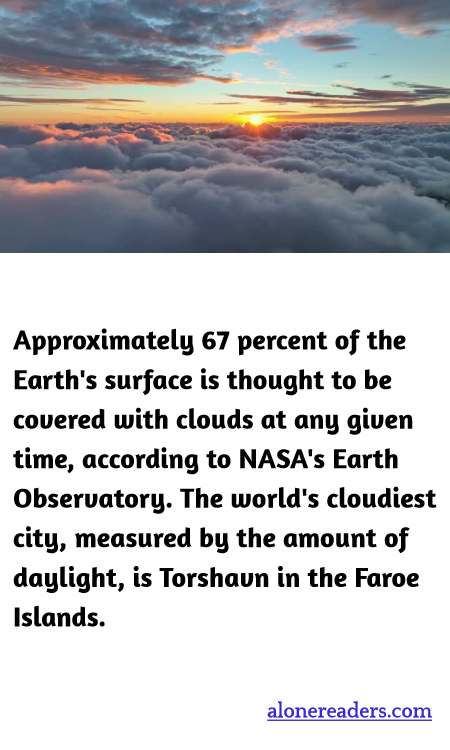
Clouds, those ever-present blankets in the sky, cover about two-thirds of Earth's surface at any given moment. This omnipresent cloud cover plays a crucial role in our planet's climate and weather systems. According to NASA's Earth Observatory, the estimate that 67 percent of Earth’s surface is typically veiled by clouds highlights their significant impact on both sunlight penetration and the distribution of solar energy. Clouds affect everything from the water cycle to temperature control, acting as insulators that can either trap heat and keep the planet warm or reflect sunlight and help cool it down.
Torshavn, the capital city of the Faroe Islands, exemplifies the extensive influence of cloud cover more than any other city on the globe. Known as the world’s cloudiest city in terms of daylight hours, Torshavn offers a unique climate shaped by its geographical position in the North Atlantic and the North Sea. This location contributes to its dense and frequent cloud cover, which significantly reduces the amount of direct sunlight received. On average, Torshavn experiences substantial cloudiness during most of the year, which not only affects the amount of natural light but also influences local weather patterns and daily life.
The extensive cloud cover in Torshavn, while challenging for solar energy harvesting and those craving sunshine, has its own set of advantages. For one, it creates a mystic and picturesque environment that is unique to this region, attracting photographers and nature enthusiasts drawn to its ethereal landscapes. Moreover, consistent cloud cover helps in maintaining a relatively stable temperature range, which is beneficial for the local ecosystems.
Globally, understanding and studying clouds is essential for predicting weather and preparing for climate variability. The data collected from places like Torshavn can help scientists to model and predict weather patterns not just locally but also in other parts of the world experiencing similar climatic conditions. As the Earth faces increasing impacts from climate change, such as shifting weather patterns and rising global temperatures, unravelling the mysteries of cloud dynamics could prove pivotal in mitigating and adapting to these changes.
Clouds, therefore, are not just passive residents of the sky but are dynamic and powerful elements of our planet’s atmosphere. The interaction between clouds and the various ecological and climatic conditions around the world continues to be a critical area of research in understanding and managing Earth’s environment.
