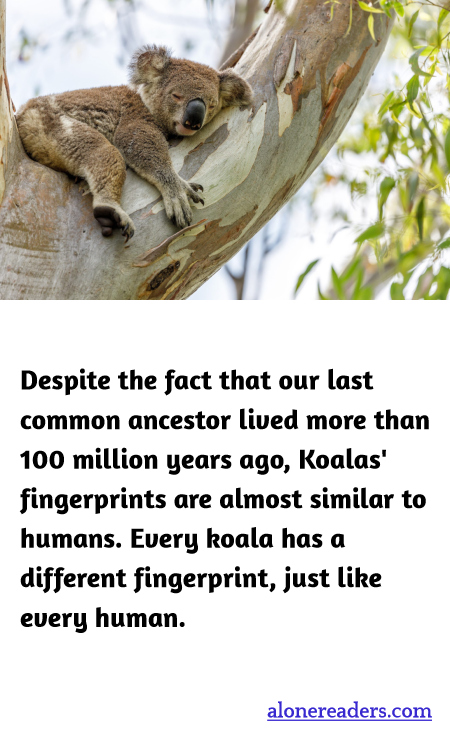
In an intriguing twist of evolutionary biology, koalas, those cuddly, tree-hugging marsupials native to Australia, share a remarkably human-like trait: their fingerprints are so similar to ours that they can confound crime scene investigations. This striking similarity raises fascinating questions about the function and evolution of fingerprints in mammals.
The discovery of the near-identical nature of koala and human fingerprints dates back to the early 1970s when police forensics noted the potential for misidentification. Under a microscope, a koala’s fingerprint is almost indistinguishable from a human's, featuring the same loops and whorls that characterize our own digit pads. This remarkable resemblance is even more surprising considering that the last common ancestor of primates and marsupials, which includes koalas, is believed to have existed over 100 million years ago.
The evolution of fingerprints in both humans and koalas is theorized to be an instance of convergent evolution, a process where unrelated species develop similar traits independently, often because they occupy similar ecological niches. For both humans and koalas, the primary utility of fingerprints is likely related to gripping. Humans use their well-defined friction ridges to grasp and manipulate objects with precision, a vital aspect of tool use. Similarly, koalas require a secure grip to climb and navigate the trees in which they spend most of their lives.
Besides enhancing grip, fingerprints may also serve a sensory purpose, enhancing touch sensitivity. The intricate patterns of ridges may help in detecting subtle textures and changes in surfaces, an attribute that could be as advantageous to a tree-dwelling koala as it is to a tool-using human.
Every koala has a unique set of fingerprints, just as humans do. This individual specificity supports social and research behaviours such as identification in scientific studies and monitoring in conservation efforts. For koalas, tracking individuals is particularly crucial in the management of their populations, especially given their 'vulnerable' status on the IUCN Red List due to habitat destruction and disease.
The similarity between human and koala fingerprints is a fascinating example of how separate evolutionary paths can converge on similar solutions to environmental challenges. It underscores not only the interconnectedness of life on Earth but also the specific, often surprising, adaptations that species evolve in order to thrive in their particular niches. As researchers continue to investigate these and other curious convergences, our understanding of evolution, adaptation, and the complex tapestry of life deepens, revealing new marvels of the natural world.
