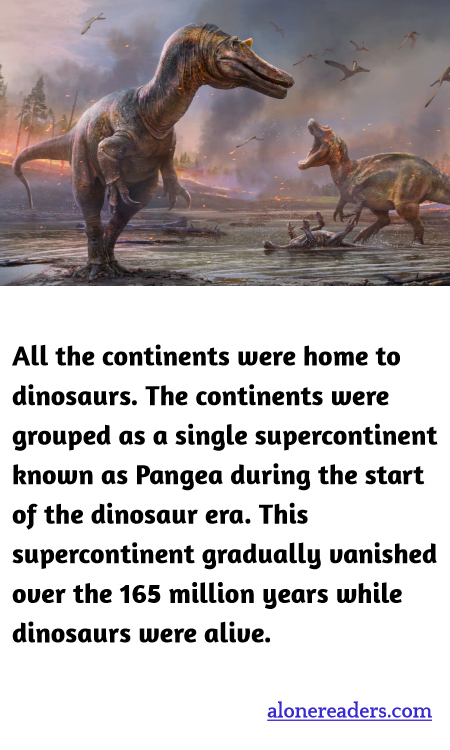
Dinosaurs, the awe-inspiring creatures that once ruled the Earth, inhabited all the continents. In the early stages of the Mesozoic Era, about 250 million years ago, the Earth looked dramatically different compared to today. All the continents we recognize were fused together into a colossal supercontinent called Pangea. Over time, as the dinosaur era prospered, Pangea began to gradually break apart due to the movements of tectonic plates beneath the Earth’s crust.
This fragmentation process spanned much of the 165 million years that dinosaurs existed and led to the formation of the continents as we know them today. The initial breakup of Pangea into two landmasses, Laurasia in the north and Gondwana in the south, around 200 million years ago, was a pivotal point in Earth’s geological history. It significantly altered the climates, environments, and the evolutionary pathways of life on Earth.
As these continents drifted apart, isolated by expanding oceans, different dinosaur species were subject to a variety of new environments. This isolation led to a significant diversification of dinosaur species. Each continent began to develop its own unique dinosaur fauna. In North America, for instance, the fierce Tyrannosaurus rex evolved, while in South America, the gigantic long-necked Sauropods like Argentinosaurus roamed.
The continental drift not only influenced the diversification of dinosaur life but also their eventual demise around 65 million years ago, when dramatic environmental changes prompted by geological and astronomical events made survival untenable for these magnificent creatures. The reshaped global map, now consisting of distinct continents, continued to influence the evolution of the surviving life forms, leading to the rich biodiversity we see today.
Thus, the narrative of the continents and their colossal shifts is intricately linked to the story of dinosaurs, from their dominance to their sudden extinction. This fascinating junction of geological activity and biological evolution showcases the dynamic nature of our planet.
