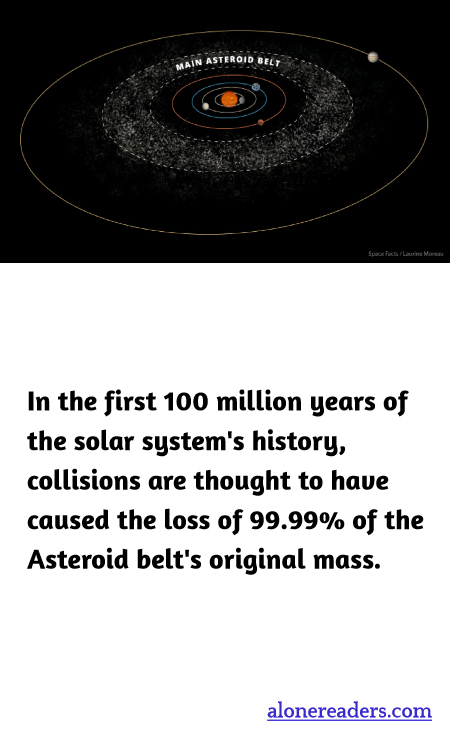
During the chaotic infancy of our solar system, approximately 4.5 billion years ago, colossal forces were at play in shaping the planets and the belts of asteroids. Among these formative events, the violent collisions within the primordial asteroid belt, which orbits between Mars and Jupiter, played a particularly pivotal role. These collisions, occurring frequently over a span of the first 100 million years, drove a dramatic reduction in mass within the asteroid belt.
Originally, the asteroid belt is theorized to have contained enough material to form a planet significantly larger than Earth. However, due to the unique conditions and processes during the solar system’s formative period, the destiny of this material was quite different. Gravitational interactions with the gas giants, particularly Jupiter, led to orbital resonances that greatly impacted the smaller bodies in the asteroid belt. These resonances increased the orbital eccentricities of objects in the belt, leading to high-velocity collisions.
These collisions were not mild fender benders but catastrophic events that shattered asteroids into smaller fragments. Over millions of years, the cumulative effect of these collisions and the subsequent ejection of debris from the belt radically depleted its mass. Today's asteroid belt is a shadow of its former self, harboring only about 0.01% of the Earth's total mass. This significant mass loss elucidates why the asteroid belt never coalesced into a planet as might be expected in a more stable, less tumultuous environment.
Further shaping this dynamic was the solar wind and pressure of sunlight which, over eons, pushed smaller particles out of the asteroid belt, dispersing them through the wider solar system or causing them to spiral into the Sun. This process, combined with continuous collisions, ensured the belt remained sparsely populated.
Understanding these early eons of asteroid impacts is crucial not only for comprehending the history and evolution of our own solar system but also for studying other star systems. Insights into the processes that dictate the formation and evolution of asteroid belts can help astronomers predict and understand similar phenomena in extrasolar environments, providing clues about the potential habitability of other systems. Through the lens of the early solar system chaos, astronomers piece together the puzzle of planetary system formation across the universe.
