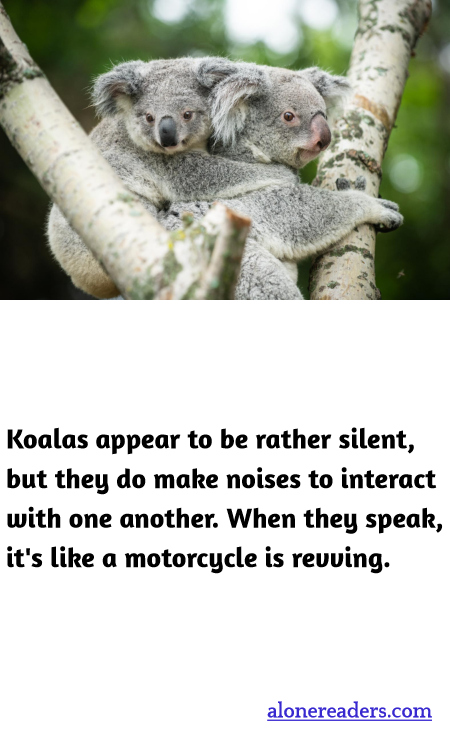
Koalas, often perceived as the silent icons of the Australian eucalyptus forests, have a surprisingly noisy side that belies their serene demeanor. These cuddly marsupials are not as quiet as one might think; they engage in quite vocal interactions to communicate with one another. The sounds they produce can be startlingly loud and deep, contrasting sharply with their gentle appearance.
The most unexpected aspect of koala communication is the sound itself: a low-pitched bellow that could be likened to the revving of a motorcycle. This rumbling vocalization serves several purposes. Primarily, it is used during the mating season. Male koalas emit this deep bellow to attract females and to assert their presence to other males. It's an auditory display of dominance and virility, resonating through the trees of their habitat.
Interestingly, the bellow of a koala is far more robust and powerful than one would anticipate from such a small animal. Researchers have found that koalas use a unique organ not found in any other land mammal to produce these sounds. This organ, known as the velar vocal folds, is located outside the larynx and enables the production of extremely low-pitched sound. This adaptation is particularly fascinating because it suggests that koalas, through evolution, have developed specialized mechanisms to enhance their ability to communicate over long distances and through dense forest cover.
The vocalizations also play a crucial role in the social structure of koalas, helping to establish and maintain territories. The bellows can carry over considerable distances, ensuring that a male's presence is known without the necessity of physical confrontation, which can be costly in terms of energy for this typically lethargic creature.
Moreover, female koalas also respond to these vocal signals, which can influence their choice in a mate. The depth and richness of a bellow may indicate the size and health of the male, important factors in the selective process of mating. Thus, these vocalizations are integral not just for communication but also for the genetic diversity and health of future generations.
Through understanding the unique vocal behaviors of koalas, we gain insights not only into their own ecological adaptations but also into the complex ways in which all species communicate and interact with their environments. Despite appearing to be creatures of silence, the noisy nature of koala communication underscores the rich tapestry of animal adaptation and survival.
