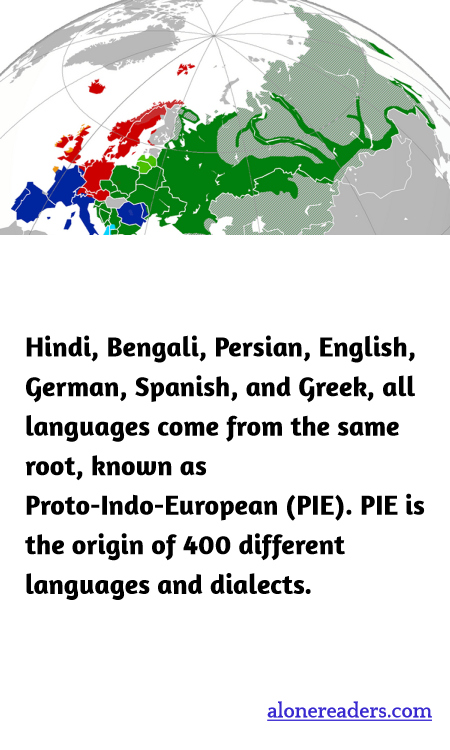
Languages, in their myriad forms and dialects, are not just tools for communication but are also deeply intertwined with culture and history. Hindi, Bengali, Persian, English, German, Spanish, and Greek may seem vastly different at first glance, both in script and pronunciation. However, these languages share a common ancestry in Proto-Indo-European (PIE), a prehistoric language that is hypothesized to be the root from which these diverse languages have evolved.
Proto-Indo-European is not attested by any written records but has been reconstructed by linguists through the comparative method. This linguistic ancestor is believed to have been spoken by a nomadic people in the steppes of Eastern Europe and Western Asia around 4500-2500 BCE. From this single source, a vast family tree of languages branched out as these ancient people migrated and settled across different regions.
The evolution from PIE to the present languages involved changes over millennia, influenced by migrations, conquests, and cultural transformations. For instance, as Indo-Europeans moved towards the Indian subcontinent and across Europe, different branches of the original language developed. These branches eventually evolved into well-defined language groups such as Germanic, Romance, Celtic, Baltic, Slavic, and Indo-Iranian.
Languages like English and German emerged from the Germanic branch, Spanish evolved from the Romance group descending from Latin, Greek maintained its individuality from the Hellenic branch, while Hindi and Bengali developed from the Indo-Aryan branch of the Indo-Iranian group. Persian, meanwhile, evolved from the Iranian branch of the Indo-Iranian languages. Each language, while retaining traces of its ancestral roots, adapted to the unique cultural, social, and environmental factors of their speakers, resulting in the rich linguistic diversity we see today.
This common linguistic heritage explains why there are surprising similarities among these languages today. For example, the English father, Persian pedar, and Hindi pitr all share the same PIE root "*p?ter". Such connections are not merely of historical interest but also help linguists understand the transformations of sounds and meanings and the rules governing them.
Thus, the study of languages like Hindi, Bengali, Persian, English, German, Spanish, and Greek reveals not only myriad differences but also unexpected similarities, drawing a fascinating map of human migration and cultural interchange. These languages, encompassing over 400 different languages and dialects stemming from PIE, embody a global heritage of linguistic evolution. Understanding their common roots helps in appreciating both the diversity and the unity of human languages.
