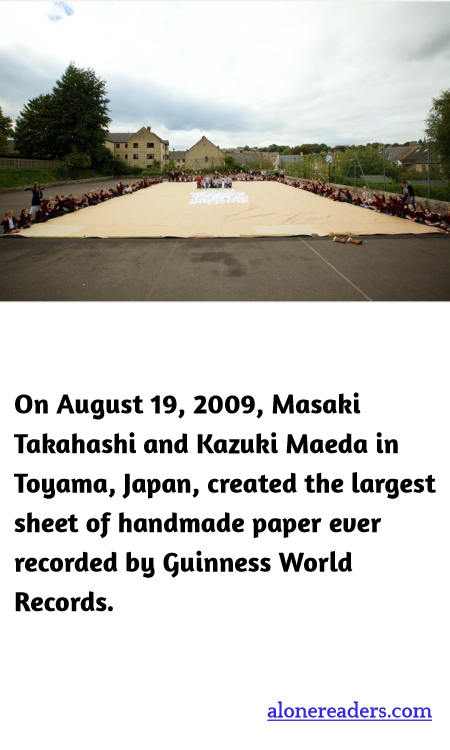
On a summer day back in 2009, a remarkable achievement unfolded in the serene town of Toyama, Japan. Masaki Takahashi and Kazuki Maeda, two individuals with a passion for traditional craftsmanship, embarked on a historic endeavor to set a world record. Their goal was ambitious: they intended to create the largest sheet of handmade paper ever recorded. The art of papermaking has deep roots in Japanese culture, dating back to the early 7th century with techniques refined over generations, yet this feat would require innovative approaches to traditional methods.
The process of making paper by hand involves suspending fibers in water and pouring the mixture onto a flat frame where the water is drained, leaving behind a mat of interwoven fibers that will then dry into paper. For this particular record-setting attempt, Takahashi and Maeda scaled up this technique to unprecedented levels. The project not only demanded meticulous planning and precision but also a deep understanding of the paper’s texture and strength, factors critical to supporting the size of the completed sheet.
With community support, the duo meticulously spread the fibrous slurry across a custom-made giant frame, ensuring an even spread and optimal thickness. After hours of careful work and constant adjustments, the sheet was left to dry, which took several days given its enormous size. Once dry, the paper measured impressively, securing its place in the Guinness World Records.
This record was more than just a remarkable technical achievement; it was a celebration of cultural heritage and the enduring relevance of traditional crafts in the modern world. Through their creativity and dedication, Takahashi and Maeda highlighted the intricate beauty of papermaking and its potential for contemporary artistic expression. The event not only put a spotlight on the painstaking skill involved in traditional Japanese papermaking, known as washi, but also inspired many by showcasing how historic practices can find new meanings and applications today.
Their accomplishment stands as a tribute to the craft’s rich history and its artisans’ willing embrace of innovation, proving that even the most time-honored techniques can still surprise and inspire a global audience.
