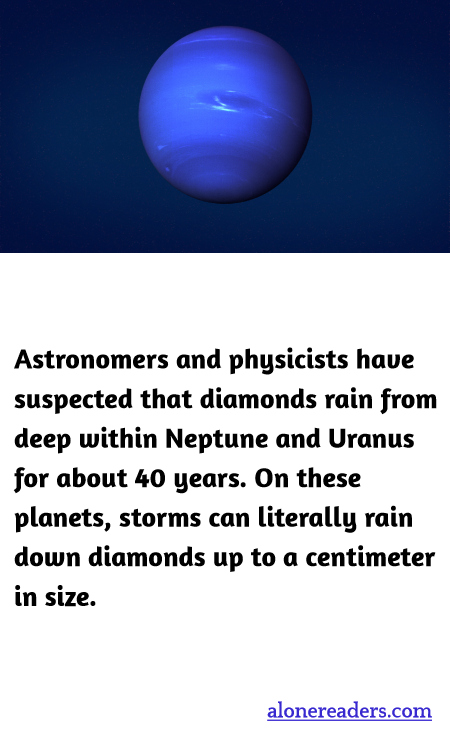
The interiors of Neptune and Uranus, two of the Solar System's outer planets, host some of the most bizarre weather phenomena imaginable. According to scientific models and experimental data gathered over the past four decades, astronomers and physicists believe that it literally rains diamonds within these distant, icy giants. This remarkable process begins deep below the planets' cloud tops, in their dense, hot interiors where extreme pressures and temperatures are prevalent.
Both Neptune and Uranus have atmospheres primarily composed of hydrogen, helium, and small amounts of water, ammonia, and methane. Under the extreme pressure and temperature conditions thousands of kilometers below their surfaces, these gases undergo remarkable transformations. Methane, in particular, is crucial for diamond formation. As pressure increases to about 10 million times Earth's atmospheric pressure and temperature soars to thousands of degrees Celsius, methane breaks down. The carbon atoms freed from this decomposition then begin to cluster together into diamond crystals, sinking gradually toward the planets' cores.
The idea of raining diamonds was initially considered theoretical until it was supported by laboratory experiments simulating the conditions on these planets. Using high-powered optical lasers, researchers replicated the intense temperatures and pressures found in Neptune's and Uranus's atmospheres. These experiments not only confirmed that diamond rain could indeed occur but also provided insights into the rate of diamond formation and the size of diamonds that could potentially develop, ranging up to centimeters in diameter.
The implications of diamond rain are profound, not just for the exotic nature of the phenomenon, but also for understanding the internal structure and evolution of these planets. As diamonds fall towards the core, they likely contribute to a unique 'mantle' layer, altering our understanding of these planets' compositions and their magnetic fields. Moreover, this process affects the thermal evolution of Neptune and Uranus by releasing gravitational energy as the diamonds settle deeper inside.
This ongoing research into diamond rain not only sheds light on the dynamic processes occurring in the outer planets of our Solar System but also boosts our broader understanding of planetary sciences. It emphasizes the complexity and variety of weather phenomena beyond Earth and challenges previous assumptions about what conditions are like on distant worlds. As our exploration technology advances, we may uncover even more wondrous and unexpected phenomena occurring in the unlikeliest of places.
