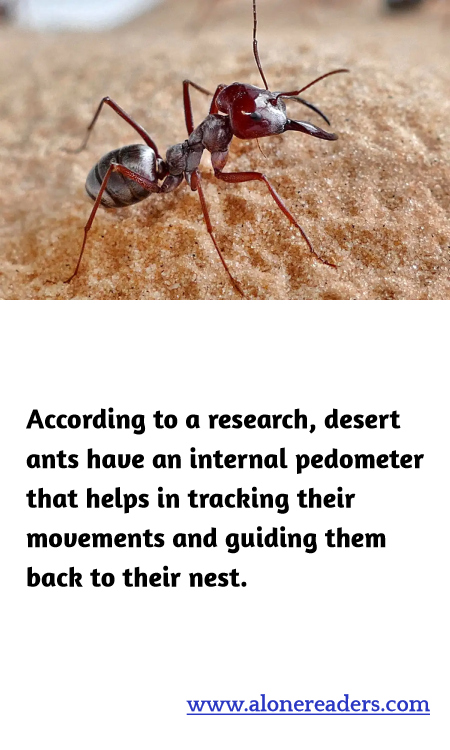
Desert ants, particularly the species known as Cataglyphis, have fascinated scientists with their extraordinary navigation abilities. These insects can travel long distances across barren desert terrain to find food, and then return directly to their nests with remarkable precision. Recent research has shone light on one of the key tools in their navigation arsenal: an internal pedometer that helps them keep track of how far they've traveled.
The discovery of this internal counting mechanism began with experiments where researchers altered the legs of the ants. They found that by lengthening the legs of some ants with stilts and shortening others by cutting off part of their legs, the ants' ability to find their way back to the nest was significantly affected. Ants on stilts went past the nest, having taken larger steps than usual, while ants with shortened legs fell short of the nest, taking smaller steps than they normally would.
This led scientists to conclude that desert ants calculate the distance to their nest by counting their steps. To do this accurately, the ants use a form of mental "odometer" that keeps track of each step taken from the nest, allowing them to estimate the return distance accurately. Aside from their internal pedometer, desert ants also utilize other navigational aids. They use visual landmarks when they are available, and they can also use the position of the sun as a compass, integrating this information seamlessly with their step count.
Another fascinating aspect of their navigational ability is their speed and efficiency in adapting to new situations. For instance, if an ant is picked up during its journey and placed down at a location closer to or further from the nest, it quickly recalculates its route. This rapid recalibration suggests a highly flexible memory and cognitive map of the terrain.
Such research not only helps in understanding the sophisticated behaviors of insects but also has potential applications in robotics and navigation systems. By studying how ants navigate using such simple tools as counting steps and observing the sun, engineers can develop new algorithms for autonomous vehicles and other technologies that require navigational capabilities in absence of GPS. Indeed, the desert ant offers a remarkable example of how creatures evolve specialized and highly effective adaptations to thrive in challenging environments.
