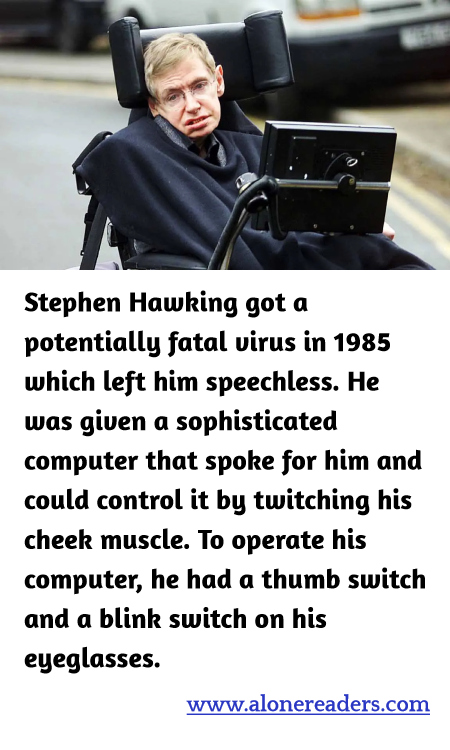
In 1985, the renowned theoretical physicist Stephen Hawking faced a major health crisis that nearly cost him his voice and his life. He contracted a virus that led to pneumonia and was so severe that it required a tracheotomy—a surgical procedure that left him unable to speak. However, this setback didn't diminish his resolve or his ability to contribute to science. Instead, it marked the beginning of a new chapter in which technology played a crucial role in enabling his communication with the world.
To overcome his speechlessness, Hawking was equipped with a cutting-edge computer system that allowed him to communicate via synthesized speech. This computer became his voice, translating his thoughts into spoken words. The system was initially operated via a hand switch, and as his condition progressed, the method evolved. Eventually, Hawking used subtle movements—a twitch of his cheek muscle—to control the device. This was achieved through a sophisticated sensor placed on his glasses, which detected the muscle movement.
This technology did not just restore his ability to communicate; it empowered him to continue his lectures, public talks, and participation in scientific discussions. The computer system was equipped with software that predicted the words he might want to use, speeding up his communication process. This predictive text functionality, coupled with his intellectual prowess, allowed Hawking to articulate complex scientific concepts to both the scientific community and the general public.
Hawking's use of technology to communicate became one of the most iconic images of a scientist overcoming disability through the power of human ingenuity and determination. It highlighted how adaptive technologies could provide voice to those who might otherwise be silenced. Stephen Hawking not only advanced our understanding of the universe but also demonstrated the potential for technology to augment human capabilities and resilience. His legacy, therefore, encompasses both his groundbreaking contributions to cosmology and his role as an advocate for people with disabilities, showing how technology can dramatically improve quality of life and provide a platform for continued professional and personal expression.
