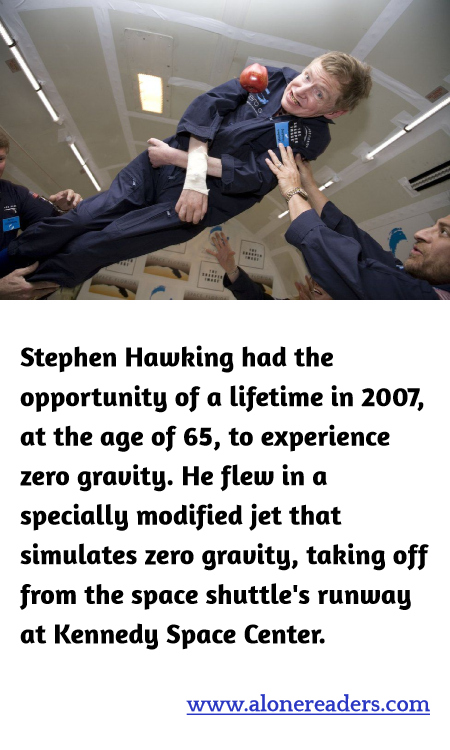
In 2007, Stephen Hawking, the renowned theoretical physicist known for his work on black holes and the nature of the universe, transcended the confines of his wheelchair to experience zero gravity. At the age of 65, Hawking took part in a flight that allowed him to float free of his physical limitations, a moment that was as symbolic as it was joyous. This extraordinary event occurred aboard a modified Boeing 727, operated by Zero Gravity Corporation, which took off from the same runway used by America’s space shuttles at Kennedy Space Center.
The aircraft, aptly dubbed "Vomit Comet", performed a series of parabolic arcs specifically designed to create a microgravity environment, allowing passengers to experience brief periods of weightlessness. Typically, each parabola affords about 25 seconds of zero gravity. For Hawking, this adventure was not merely a personal milestone but also a loud statement advocating for the possibilities available to people with disabilities and the importance of making space travel accessible to all.
Hawking's zero-gravity flight consisted of eight parabolas. During these, he was not only able to float, turning somersaults and experiencing freedom from his paralyzed state, but also demonstrated the sheer joy and exhilaration that scientific exploration can bring. Photos and videos from the flight show him beaming, a visible expression of the delight the experience brought him.
This adventure also highlighted Hawking's continuous push for space exploration. He believed that the future of humanity lay in the stars — perhaps a necessity for our long-term survival. By participating in this flight, Hawking hoped to show that space should be accessible to everyone, regardless of physical condition.
Hawking's journey into zero gravity serves as a reminder of the boundless capabilities of the human spirit to overcome obstacles. It's a poignant testament to Hawking's life, defined not by the ALS that progressively paralyzed him since his early twenties, but by his extraordinary contributions to science and his undying enthusiasm for discovery and adventure. The image of him, liberated from his wheelchair and floating in air, resonates as a powerful symbol of overcoming personal and physical limits to touch the seemingly untouchable realms of space.
