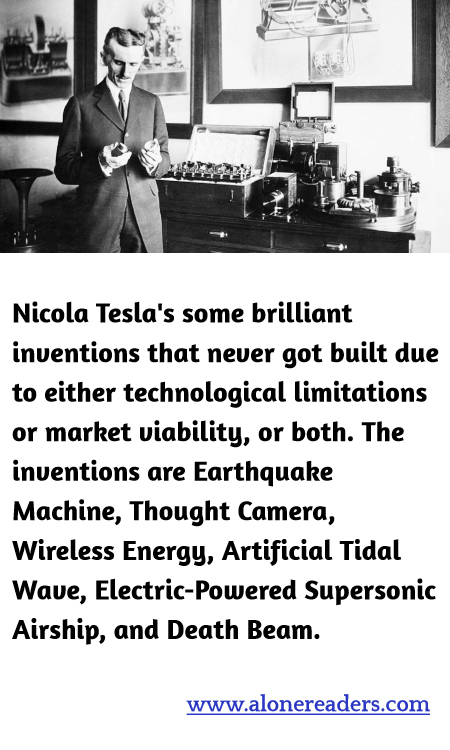
Nikola Tesla, a prodigious inventor and visionary, is known for his countless contributions to the physics and engineering realms. However, several of his groundbreaking ideas were never fully realized due to a variety of reasons, including technological constraints and market viability. Among these are some truly fascinating concepts that sound almost fantastical in their ambition and potential impact.
One of Tesla's lesser-known yet intriguing creations was the "Earthquake Machine," a mechanical oscillator that Tesla claimed could shake a building to its foundation and possibly even cause it to crumble. According to Tesla, this device, which was small enough to fit inside a person's pocket, could produce resonant vibrations that, when aligned with the natural frequency of materials, could lead to catastrophic structural failures. Tesla reportedly tested this device with some minor success, causing a small earthquake in New York City, but it never moved beyond experimental stages due to safety considerations and technological limitations.
The "Thought Camera" is another of Tesla's speculative inventions aimed at capturing visual representations of thoughts by photographing the retina, where images are believed to linger momentarily. Tesla imagined a world where thoughts could be visualized directly and potentially even recorded, an idea that blends the boundaries between science fiction and plausible technology. The inability to create such a camera at the time and the complex nature of neurological activity relegated this idea to the realm of imagination.
Tesla also envisioned a global system of "Wireless Energy" that would transmit electrical power without the need for wires, making electricity accessible even in remote parts of the world. His Wardenclyffe Tower project was an early attempt to test this theory; however, it was never completed due to financial issues and skepticism from potential investors. The technical challenges of scaling this technology and controlling it safely were enormous at the time.
Another dramatic and controversial invention was his proposal for an "Artificial Tidal Wave." Intended as a method of defense, this concept involved the use of underwater capsules that could detonate and potentially create giant waves, capable of sinking enemy ships. The ethical implications and unpredictability of the environmental impact prevented this idea from ever being developed.
Tesla's interest in aviation and space technology inspired his design for an "Electric-Powered Supersonic Airship." He envisioned an aircraft capable of traveling eight miles above the surface of the earth, moving so fast it would circumnavigate the globe in less than an hour. Constraints in materials science and a lack of advanced propulsion technology at the time kept this dream grounded.
Lastly, the "Death Beam" was another military concept proposed by Tesla. It was a particle beam weapon that Tesla claimed could bring an end to all wars by offering a supremely powerful deterrent. Despite some initial interest, the large-scale practical application, immense costs, and international fear of its implications stopped it from receiving the support it needed for development.
Tesla's unbridled imagination and confidence in the face of scientific exploration left a legacy of innovation and speculative wonder. While many of his more extravagant ideas were never realized, his work continues to inspire and challenge technological limitations, prompting modern scientists to dream big and pursue seemingly impossible feats.
