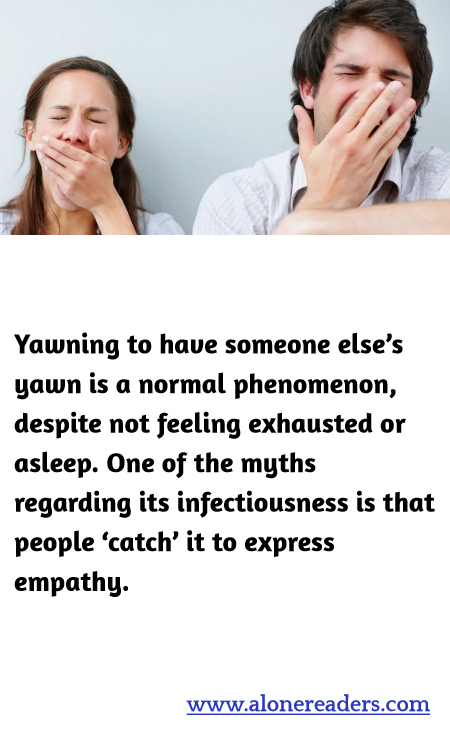
Yawning is a common physiological behavior shared by many animals, including humans. It often signifies tiredness, boredom, or the need for a change in the body's oxygen and carbon dioxide levels. Interestingly, yawning becomes even more intriguing when it occurs as a result of seeing, hearing, or even thinking about someone else yawning. This phenomenon, known as contagious yawning, extends beyond the bounds of individual experience into the realm of social interaction.
The reasons behind why yawning is contagious are not fully understood, but several theories have been proposed. One popular theory suggests that contagious yawning could be related to empathy. Empathy allows individuals to understand and share the feelings of others, and it is thought that this emotional connection could trigger the mirrored response of a yawn. Studies have shown that people are more likely to "catch" a yawn from family members or close friends than from strangers, supporting the idea that empathy plays a role. Additionally, research involving certain neurological disorders, such as autism and schizophrenia, which can affect one’s ability to express or experience empathy, suggests that individuals with these conditions are less likely to engage in contagious yawning.
However, there are other theories suggesting that contagious yawning could serve as a means of social bonding or as a non-verbal communication tool that synchronizes group behavior. The idea is that yawning might help to synchronize the moods and behaviors of a group of individuals, making social interactions smoother. Alternatively, some scientists propose that contagious yawning could be an evolutionary trait that helps in group alertness. By triggering simultaneous yawning (and thus, a temporary increase in alertness), the group might better prepare for collective activities or threats.
Despite these interesting theories, more research is needed to fully understand why yawning is contagious. While it is commonly associated with tiredness, the social implications of contagious yawning reveal fascinating insights into human behavior and social dynamics. Curiously enough, simply reading about yawning can induce the urge in others — a testament to its deeply rooted and somewhat mysterious nature in the human behavioral repertoire. Whether as an act of empathy, a social bonding mechanism, or a survival tool, contagious yawning remains a compelling aspect of human social biology.
