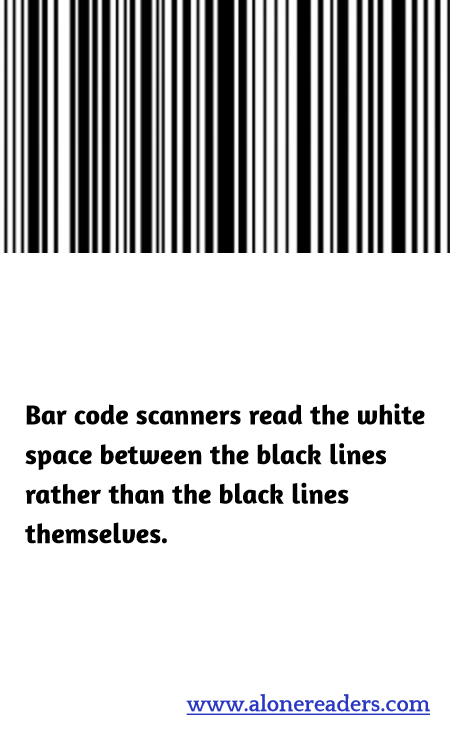
Barcode scanners are an essential tool in retail and warehousing, playing a crucial role in the management of inventory and the checkout process. Commonly, there is a misconception that these scanners operate by reading the black lines of the barcode. However, they actually function by interpreting the white spaces between these black lines.
Barcodes consist of a series of parallel black lines and white spaces of varying widths that can be read by a scanner and interpreted as numbers and data. When a barcode scanner illuminates a barcode with a red light, the black bars absorb light while the white spaces reflect it. The scanner detects this reflected light and converts it into an electronic signal. This signal is then decoded by the scanner's processor to retrieve the product information encoded within the barcode.
The technology employed in barcode scanning can vary, but the principle of detecting the white spaces remains consistent. Laser scanners, for instance, use a moving laser beam that sweeps across the barcode in a straight line. As the laser moves across the barcode, it reflects off the white spaces but not off the black bars. The pattern of reflected light is detected, converted into an electronic pattern, and then decoded.
On the other hand, image-based scanners capture an image of the barcode using a small digital camera and then use sophisticated digital image processing techniques to decode the barcode. This method also relies on analyzing the patterns of light and dark areas (the white spaces and black lines).
The data captured from these barcodes typically provide essential information such as product identification, pricing, and inventory levels. This systematic and automated method of data entry enhances accuracy and efficiency in data handling, making barcode technology an integral part of modern commerce.
Contrary to the casual eye which may see just a series of lines, the design and function of barcodes are highly sophisticated. Their ability to facilitate quick, accurate reads makes them indispensable in fast-paced environments where speed and precision are paramount. Understanding that it's the white spaces that are crucial for the reading process underscores the nuanced design and operational sophistication behind everyday barcode scanning technology. This deepens our appreciation for a technology that is ubiquitous, yet often taken for granted.
