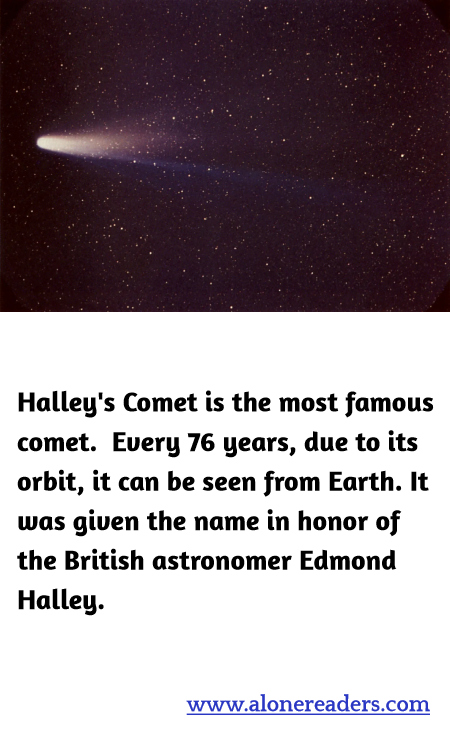
Halley's Comet, a celestial wanderer, has captured the imagination of humanity like no other comet in history. Named in honor of British astronomer Edmond Halley, who first calculated its orbit, this comet is recognized globally for its predictability and spectacular appearances that occur every 76 years. Halley was the first to determine that the comets observed in the years 1531, 1607, and 1682 were, in fact, the same object returning repeatedly. Based on his calculations, he predicted that the comet would reappear in 1758. Although Halley did not live to see his prediction come true, the comet's punctual return validated his theory and solidified his legacy.
As it swoops into the inner solar system, its icy nucleus warms up, emitting gases and dust that form a glowing coma and a distinctively long, brilliant tail that points away from the sun. These features make Halley's Comet easily visible from Earth without specialized astronomical equipment, contributing to its renown.
Halley's Comet last graced the skies in 1986, and its most recent appearance was a global event that brought together professional and amateur astronomers worldwide. It captured the public’s interest, sparking a comet fever evidenced by parties, specialized merchandise, and widespread media coverage. The comet was studied intensively by scientists who utilized advanced space technology, including the European Space Agency's Giotto spacecraft, which came within 596 kilometers of the comet's nucleus to capture valuable scientific data.
The anticipation is already building for its next pass in 2061. Each appearance of Halley's Comet offers a unique snapshot of our constantly evolving understanding of the cosmos. It also serves as a bridge across generations, offering a celestial spectacle that connects the lives of those who witness it, no matter how many decades apart. Thus, Halley's Comet remains not just a symbol of scientific curiosity and achievement but also a profound reminder of the enduring human fascination with the night sky.
