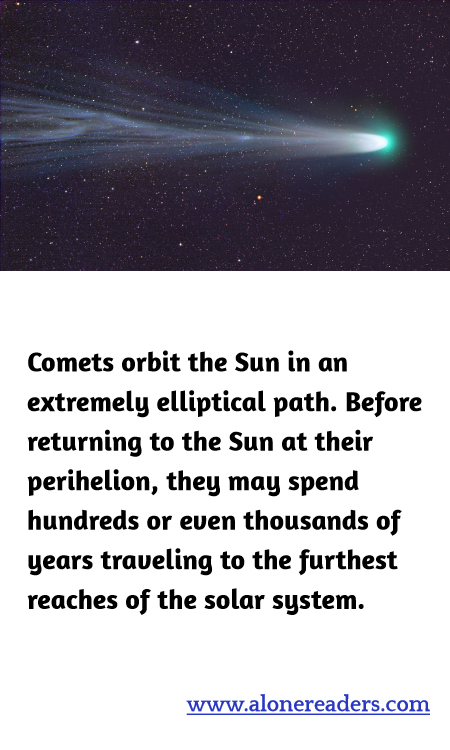
Comets, often described as "cosmic snowballs," are fascinating celestial bodies composed primarily of frozen gases, rock, and dust. They follow highly elliptical orbits that bring them extremely close to the Sun and then swing them far out into the solar system, often beyond the orbit of Neptune into the Kuiper Belt or even into the distant, mysterious realms of the Oort Cloud. This journey can take a comet hundreds, if not thousands, of years to complete.
The life of a comet begins in these outer regions, where they can remain in a state of deep freeze for millennia before any interaction with another object or the gravitational pull of the planets brings them closer towards our Sun. As they approach what is called perihelion, the closest point to the Sun in their orbit, the heat begins to vaporize the frozen gases and dust, creating what is known as a coma – a temporary, glowing atmosphere that envelopes the comet. The radiation from the Sun and the solar wind exerts pressure on this coma, pushing it away and forming a tail that always points away from the Sun, regardless of the direction of the comet’s movement.
The shape of a comet's orbit is vastly influenced by the gravitational forces of the Sun and the planets. While near the Sun, a comet’s orbit can be altered due to these immense gravitational forces, sometimes leading to a more shortened orbital period or, conversely, ejecting it out of the solar system entirely. Historical comets like Halley’s Comet, which appears every 76 years, follow relatively shorter orbital periods, making them known "periodic comets." In contrast, others might not return for hundreds or even thousands of years, or ever.
Studying the trajectory and composition of comets not only provides insight into the conditions of the early solar system but also clues about the development of the Earth itself. For instance, some theories suggest comets may have played a crucial role in delivering water and organic materials necessary for life to our planet. Every time these celestial wanderers return to the inner solar system, astronomers get another chance to study remnants from the dawn of the solar system, making each comet's journey around the Sun a floating laboratory brimming with secrets waiting to be uncovered. This cyclical journey, from the freezing outer edges to the scorching proximity of the Sun, makes comets not just spectacular celestial phenomena but also key pieces in the cosmic puzzle of our solar system’s history and evolution.
