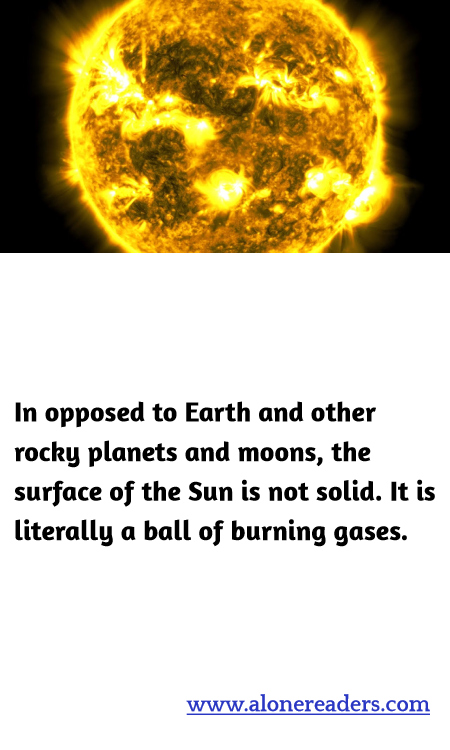
The Sun, unlike Earth and the rocky planets and moons in our solar system, does not have a solid surface. Instead, it is an immense sphere of incandescent gases, primarily hydrogen and helium, undergoing constant nuclear reactions. This massive star, at the center of our solar system, exerts a profound influence on all planetary bodies orbiting around it.
The surface of the Sun that we often refer to is actually the photosphere. This layer, visible from Earth, is where sunlight is emitted. Above this layer are the chromosphere and the corona, which can be seen during a solar eclipse as a glowing halo. The process responsible for the Sun’s energy is nuclear fusion. In the Sun’s core, hydrogen atoms combine under extreme temperature and pressure conditions to form helium, releasing vast amounts of energy in the process. This energy radiates outward to the solar surface, into space, and eventually reaches Earth, providing the light and heat essential for life as we know it.
The absence of a solid surface on the Sun means it doesn’t have a firm crust or a fixed shape like Earth. Instead, it has a dynamic and often volatile atmosphere where magnetic fields twist and turn, generating phenomena such as sunspots, solar flares, and coronal mass ejections. These solar activities can have significant effects on the space weather environment around Earth, impacting satellite operations, communications systems, and even power grids.
Understanding the Sun’s composition and behavior is crucial for scientific and practical reasons. Missions like NASA’s Parker Solar Probe and the European Space Agency’s Solar Orbiter are designed to study the Sun's outer atmosphere and its wider impact on the solar system. These missions aim to gather data that can improve our understanding of space weather forecasting and help protect Earth’s technology-dependent infrastructure.
Thus, while the Sun shares few surface characteristics with Earth or any other rocky body, its gaseous, dynamic nature drives a complex system of solar activity that affects the entire solar system, highlighting its role not only as a vital energy source but also as a significant force influencing space weather and planetary environments.
