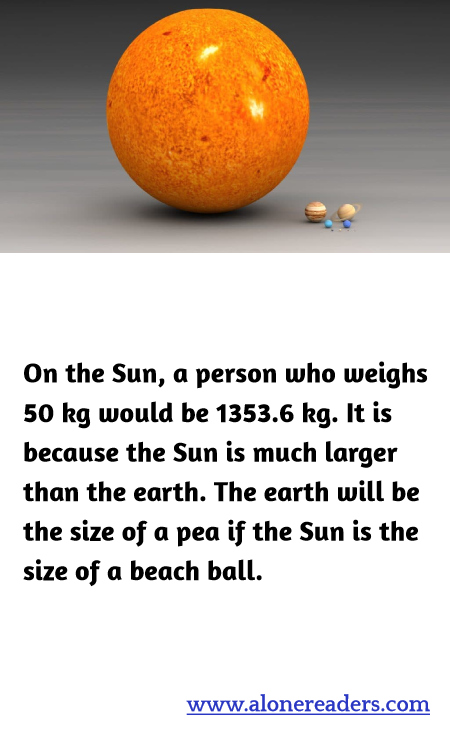
The Sun, a colossal entity in comparison to Earth, exerts a profound impact on weights due to its immense gravitational force. If a person weighs 50 kg on Earth, they would weigh an astonishing 1353.6 kg on the Sun. This substantial difference is attributed to the Sun's massive size and density.
To understand the scale, imagine the Earth as a small pea beside a beach ball, which represents the Sun. The dramatic size contrast between these two celestial bodies illustrates why gravitational forces on the Sun are so intense. The Sun is about 109 times the diameter of Earth and has a mass approximately 330,000 times greater than that of our planet. Consequently, its gravitational pull is significantly stronger.
This extreme increase in weight would make normal movement or even standing up an impossibility under such conditions. Notably, the concept is largely theoretical, as the Sun's extreme temperatures and gaseous composition would make human presence there impossible. Nonetheless, understanding these dynamics helps to enhance our comprehension of the fundamental principles of physics and the vast differences that exist within our solar system. Understanding such celestial scale not only puts into perspective the enormity of the universe but also enriches our appreciation for the delicate balance of forces that govern planetary bodies.
