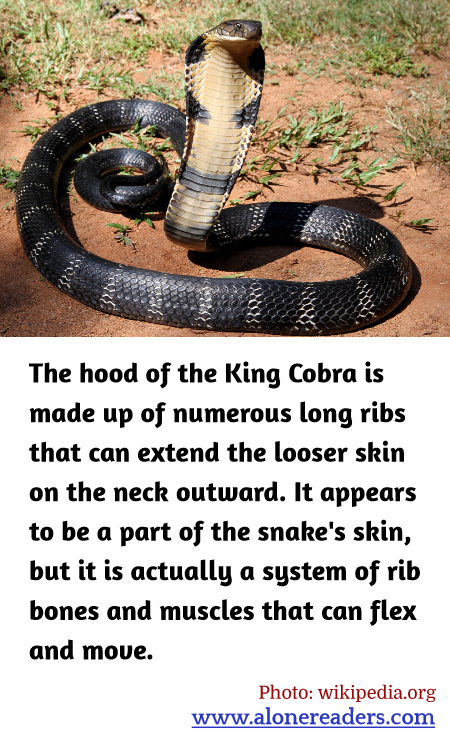
The King Cobra, one of the most majestic and revered snakes in the world, displays a remarkable feature that sets it apart from other snakes: its distinctive hood. When threatened or agitated, the King Cobra can expand its hood through an intricate system of long ribs and muscles. These ribs are elongated and specially adapted for this function, allowing them to extend the skin around the neck outward. Unlike typical ribs that primarily support the body and aid in breathing, these ribs are highly mobile and give the King Cobra its iconic silhouette when it feels the need to intimidate potential threats or during courtship displays.
This hooding behavior is not just a visual spectacle but also a crucial part of the snake's defense mechanism. By spreading its hood, the King Cobra increases its apparent size, which can deter predators and be a warning signal to back off. The muscles involved in this mechanism are strong and well-coordinated, giving the snake the ability to maintain its hooded position for extended periods if necessary.
Furthermore, the skin of the hood itself is more flexible and extensive than the rest of the body, containing elastic fibers that allow it to stretch without tearing. The coloration and patterns on the hood are unique to each individual snake and can include eyespots or other markings that enhance the intimidating effect of the display.
The hood's evolutionary development in King Cobras is a fascinating example of how animals adapt their physical structures for survival and communication. This feature not only makes the King Cobra one of the most visually striking creatures but also enhances its ability to navigate its environment and interact with other species successfully. Such adaptations underscore the complexity and beauty of the natural world, showcasing the intricate relationships between form, function, and survival.
