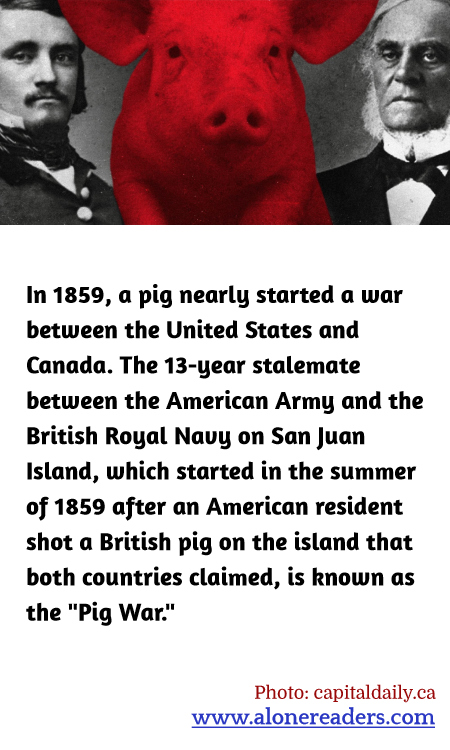
The Pig War, a peculiar conflict fueled not by grand political ideals or territorial conquests, but by the shooting of a pig, is one of the more unusual episodes in the annals of American and British history. It all began in June 1859 when Lyman Cutlar, an American farmer living on San Juan Island, found a large black pig rooting through his garden. The pig, owned by the British Hudson's Bay Company, was feasting on Cutlar's potatoes. In a moment of frustration, Cutlar shot and killed the pig.
This seemingly trivial incident escalated tensions between the United States and Great Britain, both of whom laid claim to San Juan Island, strategically located between Vancouver Island and the mainland part of the Washington Territory. The island's ambiguous national status was a result of vague phrasing in the 1846 Oregon Treaty, which left ownership open to interpretation. The death of the pig became a catalyst for action, with both nations eager to assert their sovereignty over the island.
Responding to the shooting, the British threatened to arrest Cutlar, while the American settlers called for military protection against what they feared would be a British overreach. Tensions escalated quickly, and by August 1859, American troops under the command of Captain George Pickett—later a general in the American Civil War—were dispatched to the island. In response, the British sent three warships, ratcheting up the standoff.
Both sides continued to reinforce their positions on San Juan Island, with the number of military personnel swelling to several hundred. Despite the heavy military presence, actual conflict was avoided, and the affair unfolded with a degree of absurdity. The American and British camps established on opposite ends of the island coexisted peacefully, even engaging in joint social events.
This bizarre military standoff, featuring one dead pig and no human casualties, continued until diplomacy finally took its course. In 1871, the Treaty of Washington was signed, and the issue was referred to Kaiser Wilhelm I of Germany for arbitration. In 1872, the Kaiser's commission ruled in favor of the United States, granting them possession of San Juan Island, and the British withdrew without further ado.
The Pig War stands out as a testament to the idiosyncrasies of history. It underscores how small, unforeseen events can spiral into major diplomatic incidents. Fortunately, in this case, cooler heads prevailed, allowing the "war" to be remembered more as an anecdote of international relations, rather than a bloody conflict. The incident left behind a legacy of peaceful dispute resolution and the important role diplomacy plays even in seemingly trivial matters.
