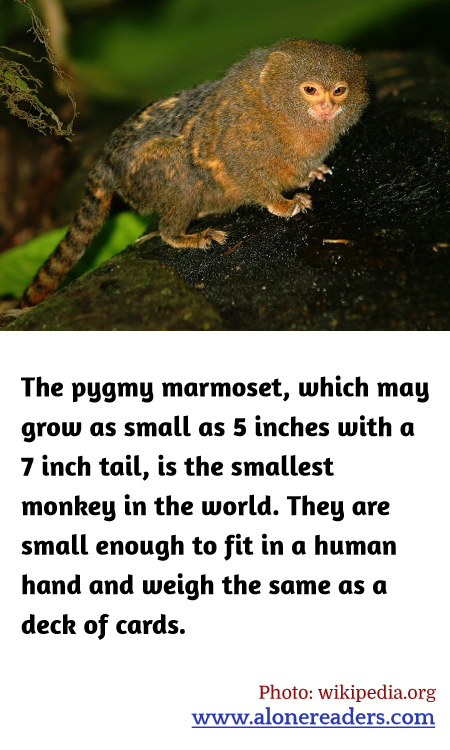
The pygmy marmoset, officially the smallest monkey in the world, is a fascinating creature both due to its diminutive size and its unique behaviors. Native to the western Amazon Basin in South America, this tiny primate rarely grows larger than 5 inches in body length, with a 7-inch tail adding to its petite stature. Weighing in at around 100 grams, roughly the same as a deck of cards, pygmy marmosets are small enough to fit comfortably in a human hand.
Despite their small size, pygmy marmosets are remarkably adapted to their dense forest environments. They have special dental adaptations that allow them to pierce tree bark to feed on the gum and sap, which forms a significant part of their diet alongside fruit and insects. Their sharp claws aid in climbing the trees of their habitat, making them excellent jumpers and climbers, essential for evasion from predators and for hunting small prey.
Living in family groups of typically about five to nine individuals, pygmy marmosets are highly social creatures. Their communication involves a complex system of vocalizations, body language, and chemical signals to interact with each other and establish territory. One of the most distinctive features of their communication is their high-pitched calls, which are often beyond the range of human hearing.
The breeding of pygmy marmosets involves care from all members of the group. Twins are common, and the responsibility of carrying the infants typically falls to the father and other group members, except when the mother is nursing. This collaborative approach helps ensure the survival of offspring in the challenging jungle environment.
Conservation efforts are being employed to protect the pygmy marmoset, whose existence is threatened by habitat destruction and the illegal pet trade. The allure of their tiny size and cute appearance makes them targets for illegal animal traffickers. Protecting their natural habitats and enforcing laws against illegal trading are crucial in ensuring that these miniature primates thrive in their natural environment. Through continuing education and conservation efforts, there is hope that future generations will also be able to experience the wonder of the world's smallest monkey.
