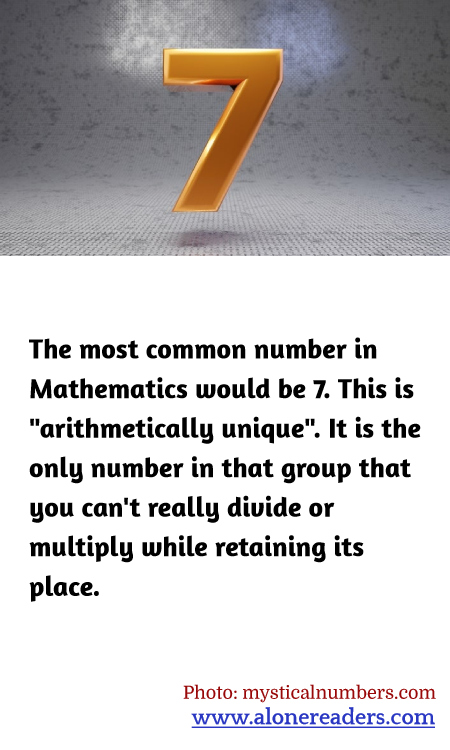
The number 7 has long fascinated both mathematicians and cultural theorists alike, bearing qualities that seem to set it apart from other numbers. Often hailed as the most popular number, 7's appeal lies not just in numerology, but also in its mathematical properties, making it a subject of considerable interest and debate.
In terms of its arithmetic properties, 7 is a prime number, meaning it is greater than 1 and cannot be formed by multiplying two smaller natural numbers. This prime status grants it a certain mathematical purity, as it is only divisible by 1 and itself without leaving a remainder, thus maintaining its distinct numerical identity across basic operations. Unlike more composite numbers, which can be broken down into multiple factors, 7 stands alone.
Beyond its primality, the number 7 does not neatly fit into the usual patterns observed in multiplication and division. For instance, multiples of 7 (14, 21, 28, 35, etc.) do not occur as regularly or predictably on standard multiplication tables as those of more factor-friendly numbers like 6 or 8. This unpredictability carries over into division, where dividing by 7 typically results in a repeating decimal, such as 1/7 equaling approximately 0.142857 repeating. This endless decimal further underscores 7’s complexity and uniqueness.
7's distinctive properties have contributed to its perceived mystique and symbolic significance in various cultures. It appears frequently in literature, mythology, and religious texts - consider the seven wonders of the world, the seven days of creation, or the seven deadly sins. This prevalence suggests that beyond its mathematical uniqueness, 7 resonates on a deeper, almost universal level.
Hence, while it can be debated which number is the most "common" in mathematics, 7 certainly stands out due to its arithmetical uniqueness and the array of distinctive properties that continue to capture the imagination and interest of mathematicians and laypeople alike.
