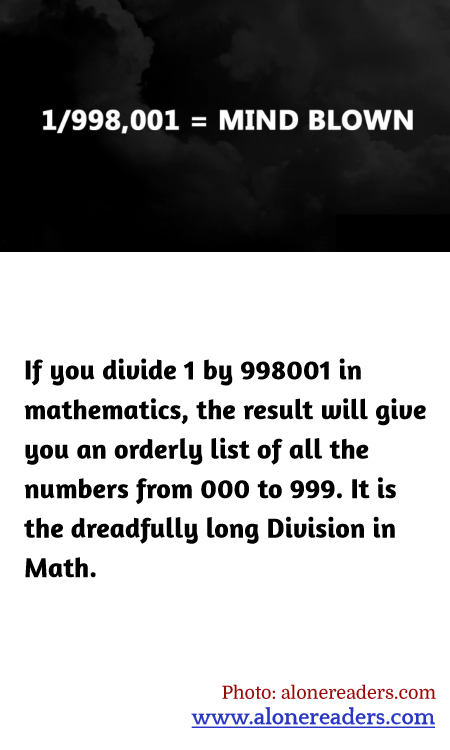
When dividing 1 by 998001, an unexpectedly fascinating pattern emerges in the resulting decimal. It appears to detail an ordered sequence of three-digit numbers from 000 to 999, a phenomenon that catches the interest of both amateur and professional mathematicians alike.
The number 998001 holds a curious place in mathematics, primarily because of its relation to the digits it generates upon division. The division of 1 by 998001 yields a repeating decimal that intriguingly encapsulates all three-digit numbers (from 000 to 999) in sequence. This is a reflection of its mathematical properties; 998001 is a rare kind of number, placing it in the domain of recreational mathematics due to its capacity to generate such a unique and orderly pattern.
Such phenomena are linked to the properties of cyclic numbers and full reptend primes in number theory. A cyclic number is a number in which cyclic permutations of the digits are successive multiples of the number, and full reptend primes result in recurring decimals that use all possible digit sequences exactly once before repeating. Although 998001 is not a prime number, it behaves similarly in generating a decimal cycle that exhaustively represents all the three-digit combinations.
The mathematical exploration of dividing 1 by 998001 not only highlights the wonders and curiosities inherent in number theory but also demonstrates the beauty of seemingly simple arithmetic operations producing complex and beautiful patterns. It serves as a reminder that mathematical exploration often yields unexpected insights and that there is still much to discover in the vast landscape of numbers. This specific operation proves an excellent educational tool, revealing the intricate interplay of numbers in a way that is both accessible and engaging, sparking interest and curiosity about the deeper properties of numbers and their behaviors under various operations.
