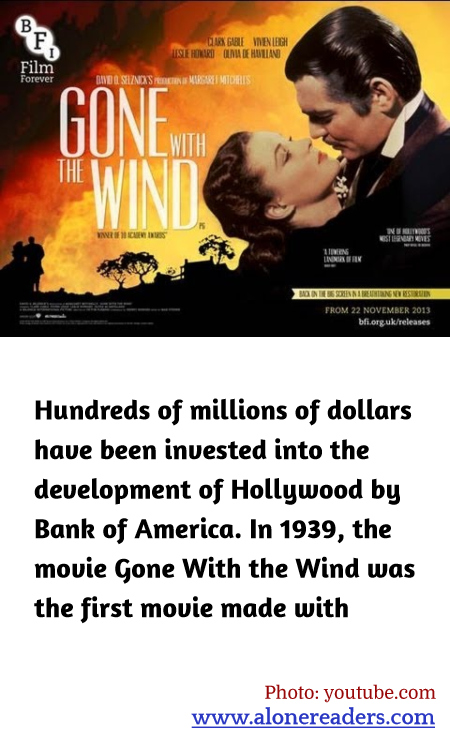
Bank of America's involvement in financing Hollywood ventures has significantly shaped the landscape of American cinema. The relationship dates back to the late 1930s, marking a pivotal turn when the bank took a groundbreaking step by funding the production of "Gone With the Wind" in 1939. This film, an adaptation of Margaret Mitchell's novel, was not only a critical and commercial success but also a historical milestone in cinema. The decision by Bank of America to finance the film paved the way for more financial institutions to consider the film industry a viable investment field, thereby fueling the industry’s expansion and technological advancement.
The investment in "Gone With the Wind" was a risky move during a time when the country was still recovering from the Great Depression. However, the film's unprecedented success, demonstrated by record-breaking box office earnings and multiple Academy Awards, including Best Picture, validated Bank of America's investment and sparked a trend of blockbuster funding. This massively influential financing model opened new financial avenues for large-scale productions that previously weren’t feasible, leading to the Golden Age of Hollywood during which some of the most iconic films in history were produced.
Over the decades, Bank of America has continued to play a significant role in Hollywood. Their ongoing investment has not only supported various facets of movie production but has also extended to the broader entertainment sector, including television and emerging digital content platforms. This enduring partnership underscores a mutual growth relationship where financial support is reciprocated by thriving entertainment outputs enjoyed both domestically and globally.
Moreover, these large-scale funding opportunities have helped Hollywood studios command the global entertainment landscape, driving innovation in storytelling and filmmaking technology. This synergy between finance and creativity continues to evolve, powering ambitious projects that attract talent, push artistic boundaries, and captivate audiences worldwide. Bank of America's pioneering move in 1939 has thus had lasting implications, echoing throughout the film industry and beyond, illustrating the profound impacts of corporate investment in cultural enrichment.
