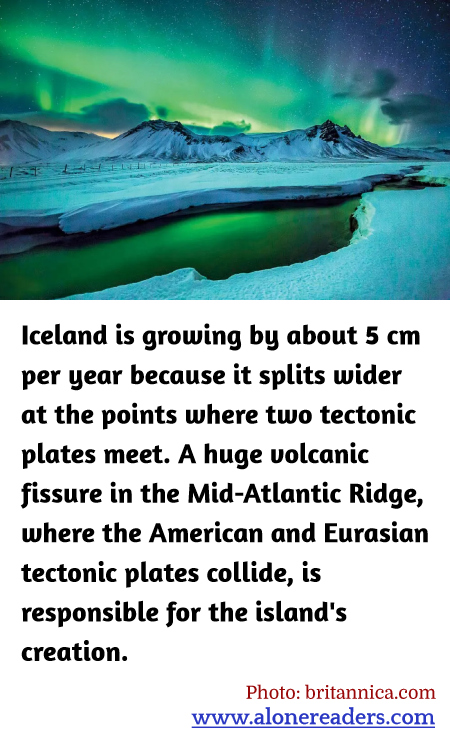
Iceland, often dubbed the land of fire and ice, is a unique case study in geological dynamics. The island is not only renowned for its stunning landscapes, polar wonders, and volcanic activity but also for its fascinating geological growth. Each year, Iceland grows approximately 5 centimeters due to the movement of the tectonic plates on which it sits. This expansion is particularly noticeable at the Mid-Atlantic Ridge, the underwater mountain range that extends down the middle of the Atlantic Ocean and emerges above sea level right through Iceland.
The Mid-Atlantic Ridge represents a boundary between the North American and Eurasian tectonic plates. These plates are moving apart, a process known as rifting, which occurs at a rate of about 2.5 centimeters per year per plate, contributing to Iceland’s annual increase in size. This rifting is driven by the movement of molten material from deep beneath the Earth’s surface, which rises to fill the gap created by the separating plates. As this molten material cools and solidifies, it forms new crust, continuously adding to the island’s structure.
This geological activity is most visibly manifested in the dramatic landscapes of Iceland, featuring vast volcanic fields, rugged lava formations, towering mountains, and deep fjords. The island boasts numerous active and dormant volcanoes, geysers, and hot springs, all results of its position straddling one of the world's most active volcanic areas. The continuous geological activity not only shapes the physical appearance of Iceland but also has profound implications on its culture and economy, supporting a rich tradition of myths, an abundance of geothermal energy, and a thriving tourism industry centered around its unique natural environments.
The constant expansion of Iceland serves as a live demonstration of plate tectonics and offers a unique opportunity for scientific research. Geologists and volcanologists from around the world are drawn to Iceland to study the natural processes at work, contributing valuable insights into the dynamics of Earth’s surface. As the island continues to grow and shape itself, it reminds us of the ever-changing nature of our planet.
