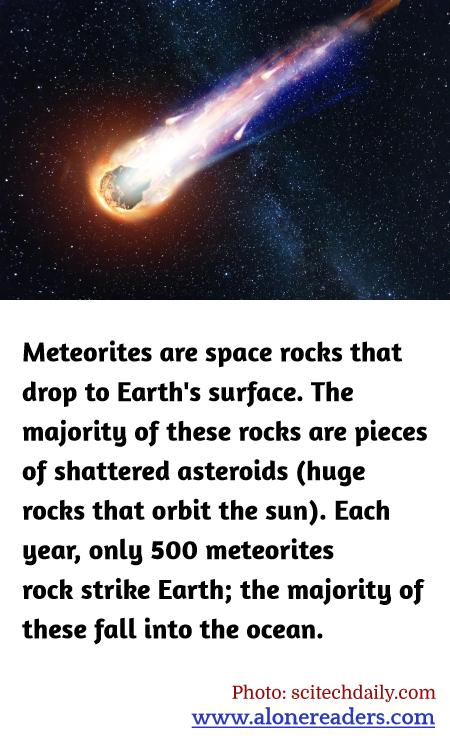
Meteorites are captivating remnants of the cosmos that find their way to Earth, offering us tangible pieces of space history. As remnants from the early solar system, they provide crucial insights into the formation and evolution of our solar system. These space rocks, primarily fragments of disintegrated asteroids, embark on a journey through space before entering Earth's atmosphere.
Interestingly, despite the thousands of meteoroids that pummel through Earth's atmosphere annually, most of them are too small to survive the journey. As they pass through the atmosphere, friction, pressure, and chemical interactions with atmospheric gases cause most of them to burn up in a fiery display that we observe as shooting stars or meteor showers. However, those that withstand this intense journey and reach the Earth’s surface are termed meteorites.
Each year, an estimated 500 meteorites manage to make it through, but a significant number of these end up in the ocean. Given that oceans cover approximately 71% of Earth's surface, it’s no surprise that many meteorites remain unrecovered, resting on vast, unexplored ocean floors. The ones that land on terrestrial grounds provide a rare opportunity for scientists to study.
Upon retrieval, each meteorite has a unique tale to relay, revealing not only the history of our own planet but also offering clues about the broader cosmos. They are studied for age, mineral composition, magnetic properties, and isotopic compositions—each parameter providing layers of data about the meteorite's origin, the age of the solar system, and occasionally about the conditions of space.
These meteoric visitors have also significantly contributed to scientific advancements. For instance, analysis of some meteorites shows organic compounds, strengthening theories about extraterrestrial origins of life. The isotopic record preserved within them can also explain processes leading to the formation of planets.
Despite their rarity, the information gleaned from meteorites is invaluable. They are not merely stones falling from the sky but are messengers from the past, holding secrets of the universe that might be crucial for understanding not only the history of our planet but of the entire cosmic landscape.
