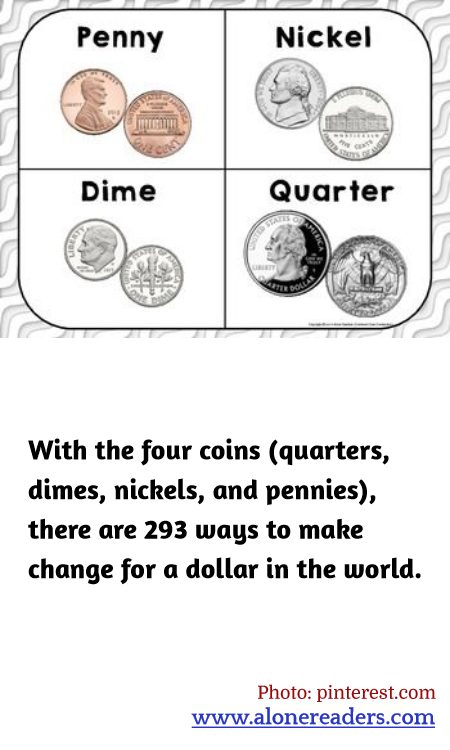
Making change for a dollar using quarters, dimes, nickels, and pennies is an intriguing mathematical challenge that reveals the complexity hidden within simple tasks. When examining all the possible combinations of these coins that sum up to 100 cents, it turns out there are 293 different ways to do so. This fact not only serves as a fun trivia piece but also provides insight into the principles of combinatorics and currency system design.
To understand how these combinations work, consider the different strategies that one might employ. For example, using quarters, one could use anywhere from zero to four of them (since four quarters make exactly one dollar). With each of these scenarios, the remaining amount must be achieved using dimes, nickels, and pennies. This breakdown further complicates as the smaller denominations themselves can be exchanged in various ways. For instance, once the decision about how many quarters to use has been made, the number of ways to distribute the remaining cent amount among dimes, nickels, and pennies adds multiple layers to the count.
The approach to finding all the possible combinations typically involves creating and solving a problem of partitioning numbers. Each type of coin adds a variable constraint depending on its value. For instance, a single nickel can replace five pennies, and a dime can replace two nickels or ten pennies. This interchangeable nature allows for an extensive pattern of possibilities which leads to the surprisingly high number of 293 different ways to make a dollar.
In educational contexts, teachers often use this coin challenge to enhance students' understanding of basic arithmetic, introduce them to fundamental concepts in probability and statistics, and foster problem-solving skills. It is also a practical exercise that can help young students grasp the value of money and basics of finance.
Furthermore, in studying the ways to make a dollar, one appreciates the design and reasoning behind the denomination and distribution of currency. It represents a balance between simplicity for trade and convenience against the complexity of smaller transactions.
In conclusion, the myriad ways to make change with the four denominitional coins reveal the depth and practical application of elementary mathematics. It's a captivating example of how ordinary elements of everyday life can embody broader mathematical principles. This concept not only enriches academic pursuits but also enhances the practical understanding of economics and finance, showing that even the simplest set of coins has a story to tell.
