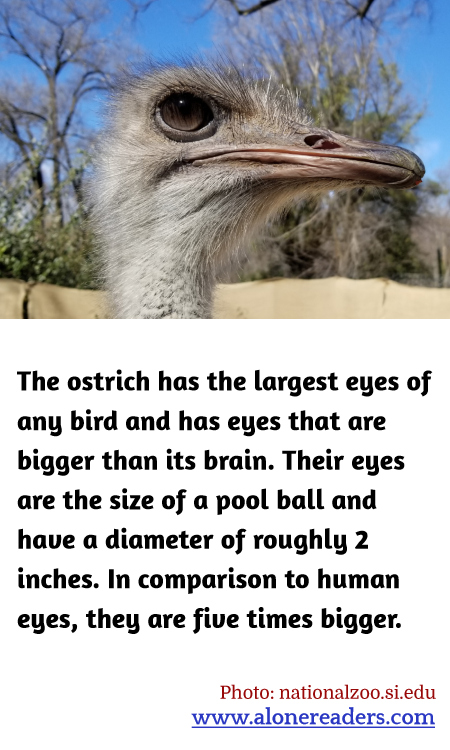
Ostriches, remarkable for many reasons, have an extraordinary feature that sets them far apart from other birds: their eyes. These creatures boast the largest eyes of any bird in the world, with each eye measuring about 2 inches in diameter, roughly the size of a billiard ball. This large eye size is not merely a trivial fact; it plays a critical role in the survival and behavior of these flightless birds.
Given their terrestrial life, ostriches need exceptional vision to spot potential threats from afar across the vast, open landscapes they inhabit, such as savannas and deserts in Africa. Their large eyes afford them a wide field of view and excellent visual acuity, which is necessary to detect predators like lions and hyenas from considerable distances. This early detection system allows them enough time to either flee — using their powerful legs capable of reaching speeds up to 70 km/h — or to prepare to defend themselves if escape is not an option.
Interestingly, the size of an ostrich's eyes means they are bigger than its brain, a fact that highlights their importance to the bird's overall physiology and survival strategy. Relative to humans, whose eyes are on average about 24 millimeters in diameter, the eyes of an ostrich are more than five times larger. This size not only provides a broader visual capacity but also enhances their ability to process movement and subtle changes in the environment quickly.
Despite their size offering them a superior vision, it is fascinating how evolution has tailored ostrich eyes to suit their specific needs. Their horizontally elongated pupils provide a wider panoramic view, allowing them to monitor the ground and horizon effectively for threats and opportunities. Yet, they can focus on objects at different distances, a vital trait for evaluating threats or foraging for food in their sparse environments.
In sum, the ostrich’s impressive eyes are a key adaptation that has enabled it to thrive in harsh environments, emphasizing the intricate connection between an organism’s traits and its habitat. Doubling as a spectacular example of natural evolution, the ostrich not only fascinates with its unique physique but serves as a reminder of the exquisite complexity of the animal kingdom.
