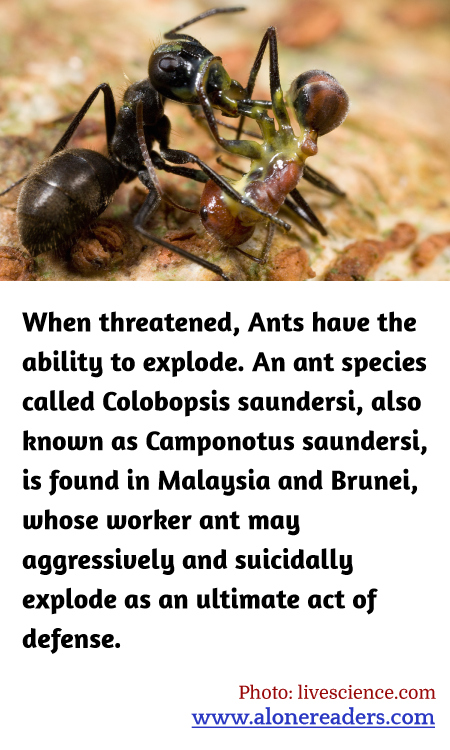
In the intricate world of ants, where each species has adapted uniquely to survive, one of the most dramatic survival tactics can be found among the Colobopsis saundersi, also known as exploding ants. Found predominantly in Malaysia and Brunei, these ants have developed a self-sacrifice strategy that benefits their colony. When threatened by predators, worker ants of this species can explosively rupture their body wall. This act releases a sticky, toxic substance, which not only deters predators but can also immobilize or kill them, thus protecting the colony.
The ability to self-destruct is a peculiar and extreme form of altruism. Unlike other defensive mechanisms seen in the natural world, where the objective is survival, the exploding ant’s mechanism is geared entirely towards colony defense, at the cost of its own life. The ants’ glands are filled with a toxic biochemical cocktail, which, upon detonation, forms a glue-like substance that entangles and incapacitates threats. This fatal defense strategy is triggered when an ant is critically endangered and feels that the threat could potentially devastate its entire colony.
This dramatic defense mechanism underscores the importance of the colony over the individual in certain ant societies. The exploding ants specifically have a caste system where some workers are more prone to self-detonation. These “kamikaze” ants are generally older workers, which highlights a resource allocation strategy where the more expendable, less reproductive individuals protect the younger, fertile members, ensuring their genes are passed on.
The study of exploding ants not only captivates those with an interest in entomology but also offers insights into the evolutionary strategies of social insects. It raises questions about the balance of individual sacrifice and group survival, as well as the extreme adaptations organisms have evolved to ensure their survival. Moreover, understanding these mechanisms can potentially lead to developments in biomimetic materials and strategies in human technology, particularly in areas requiring self-healing or self-sacrificing materials.
Exploding ants indeed epitomize nature’s complexity and the lengths to which evolution will go to preserve life, in this case, the life of a colony over the individual. As researchers continue to study these remarkable creatures, they uncover more layers of their sophisticated social structures and survival strategies, reminding us of the intricate and interdependent fabric of life on Earth.
