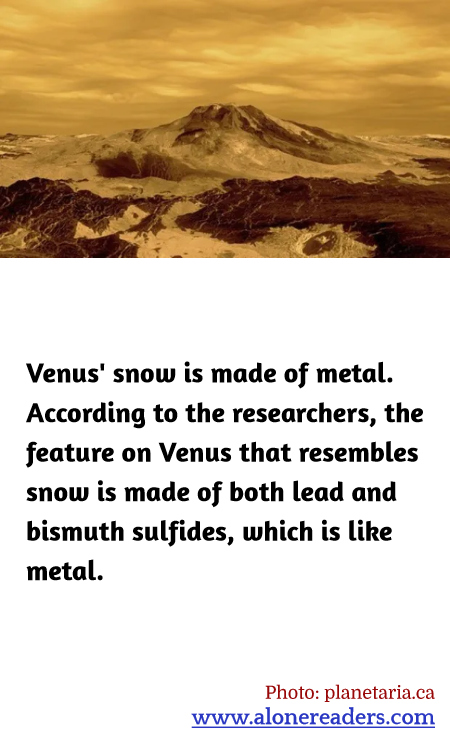
Venus, often referred to as Earth's sister planet due to its similar size and proximity to the Sun, presents one of the most inhospitable environments in our solar system. Unlike Earth's snow-capped peaks, covered in frozen water, Venus sports a bizarre phenomenon of metallic 'snow' on its mountain tops. The extreme surface conditions of Venus, characterized by a thick atmosphere laden with carbon dioxide and clouds of sulfuric acid, lead to surface temperatures that soar up to 900 degrees Fahrenheit (475 degrees Celsius). Such harsh conditions preclude the existence of water-based snow and reveal a world with startling contrasts to our own.
The snow on Venus, as discovered by scientists using data from radar observations and probe landings, consists of compounds not akin to any winter scene on Earth. Instead of water ice, Venus's high mountain peaks are capped with deposits of lead sulfide and bismuth sulfide. These metals condense out of the atmosphere and settle as frost. This occurs because the higher altitudes on Venus are cooler, though still blisteringly hot by earthly standards, making them the perfect environments for these metallic compounds to condense.
Lead sulfide and bismuth sulfide are both minerals that naturally occur as the minerals galena and bismuthinite, respectively. On Venus, these sulfides likely form when volcanic activities emit sulfur and trace metals into the atmosphere. The metals then combine with sulfur to form sulfides, later condensing due to the lower temperatures at the higher altitudes. The result is an alien snowscape of metal, blanketing the Venusian highlands not with a soft powder but with a metallic sheen that shines under the weak sunlight penetrating the dense clouds.
The discovery of metallic snow on Venus isn't only fascinating because of its stark difference from Earthly phenomena but also informs us about the planet's geological and atmospheric processes. Understanding Venus's atmospheric composition and its geophysical responses to these conditions provides scientists with important clues about other planets with extreme environments. This not only helps in comparative planetology—using planets to understand others within the solar system—but could also apply to the study of exoplanets, or planets outside our solar system, aiding in the identification of potentially habitable environments or resource-rich planets.
Venus continues to serve as a reminder of the sublime complexity and diversity of planetary landscapes within our solar system, providing invaluable insights into how remarkably different yet fundamentally similar planetary workings can be. Discoveries like these metallic snowcaps provoke curiosity and drive the scientific pursuit of understanding the cosmos.
