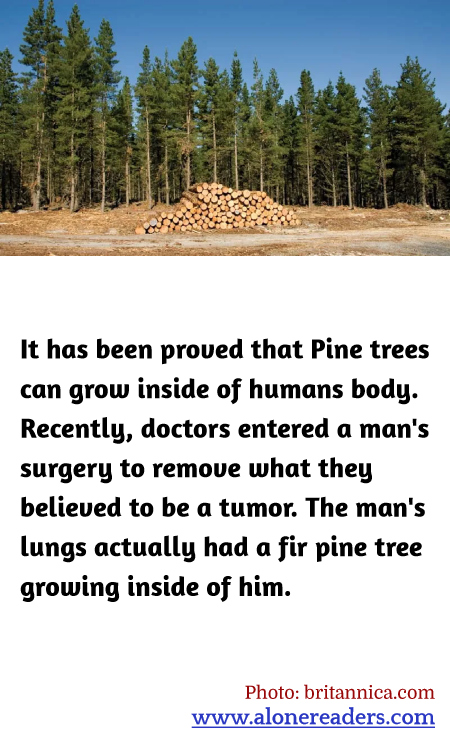
The recent news about a pine tree found growing in a man’s lung challenges our understanding of biological possibility and stirs a mix of awe and disbelief. This bizarre medical anomaly came to light when surgeons, anticipating to remove a tumor from a patient’s lung, discovered a tiny fir tree instead. The case becomes even more intriguing considering the inhospitable nature of the human body for plant life, particularly due to the absence of sunlight essential for photosynthesis.
Theorists suggest that the seed of the tree might have been accidentally inhaled by the patient and found a way to implant itself in the lung’s tissue. While cases like these are rare, they are not entirely unique. There have been isolated incidents reported before where seeds or plant material have begun to sprout within human bodies, usually in the lungs or nasal cavities, where accidental inhalation is most plausible.
Medically, such a phenomenon poses questions about the resilience and adaptability of seeds. It underscores nature's tenacity, but it also highlights potential risks in human respiratory health. Seeds can remain dormant for a long time, and under right conditions, can germinate and grow, even in unlikely environments.
This case not only opens discussions in the medical community about the precautions needed to prevent such rare occurrences but also awakens a broader curiosity about the boundaries between the plant world and our own. The idea that a living plant could start to grow inside a human being sounds like something out of a surrealist novel, yet it stands as a testament to the unpredictability of nature and the complexities of the human body.
It's crucial, however, to approach such stories with a sense of cautious fascination. The viability of a plant growing in such conditions typically defies conventional botanical science, and continuous medical studies are essential to unravel how these incidents are possible and how they can be managed or prevented.
Such narratives compel us to reevaluate our assumptions about human biology and extend our understanding of the interactions between living organisms. They remind us of the delicate balance of life and the extraordinary cases that occasionally emerge at the intersections of different realms of natural life.
