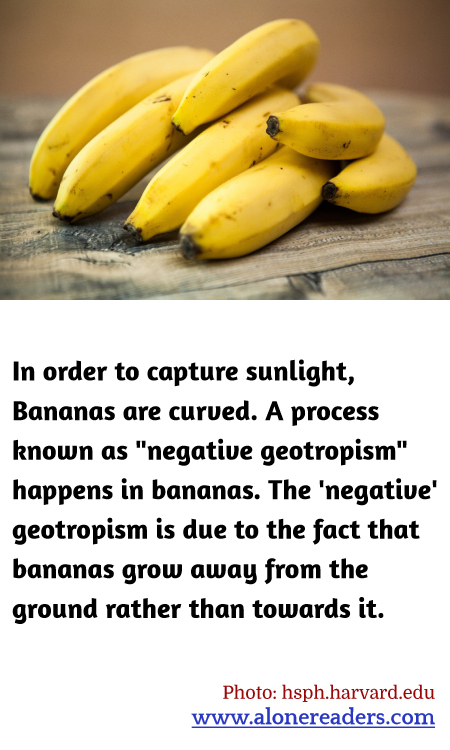
Bananas, those yellow, crescent-shaped fruits that are enjoyed worldwide, possess a unique feature that might have sparked curiosity about their curved shape. Contrary to common belief, the curvature of bananas has a scientific explanation rooted in their growth process, specifically known as "negative geotropism."
Geotropism refers to the growth of plants in response to gravity. In most plants, this results in roots growing downward and stems growing upward. Bananas, however, exhibit negative geotropism, meaning they grow in the opposite direction of gravitational pull. Initially, banana fruits grow downward, adhering to the typical response observed in plants due to gravity. However, as they mature, they begin to undergo a transformation driven by both their genetic makeup and environmental factors.
As a banana tree's fruit develops, hormonal changes within the plant initiate a pivotal shift in the way the fruit grows. The stalk (inflorescence) of the banana bends towards the light, engaging in a phenomenon known as phototropism, where plants grow towards their light source. This combined interaction of negative geotropism and phototropism causes the banana to turn upwards, away from the ground, and curve towards the light, optimizing light absorption which is crucial for its growth and development.
This curvature serves a significant purpose. It helps the bananas avoid the ground, reducing the risk of disease, pest attacks, and physical damage. Additionally, their unique shape facilitates the bunches to spread out and bear the weight of the fruits more effectively, preventing them from snapping under the pressure.
Thus, the curve in bananas isn't merely a whimsical trait but a strategic growth pattern that maximizes their chances for survival and reproduction. By curving upward, bananas expose themselves more effectively to sunlight, enhancing photosynthesis and ensuring that the fruits develop properly. This intriguing natural strategy highlights the fascinating ways in which plants adapt to their environments to optimize their growth and ensure the continuation of their species.
