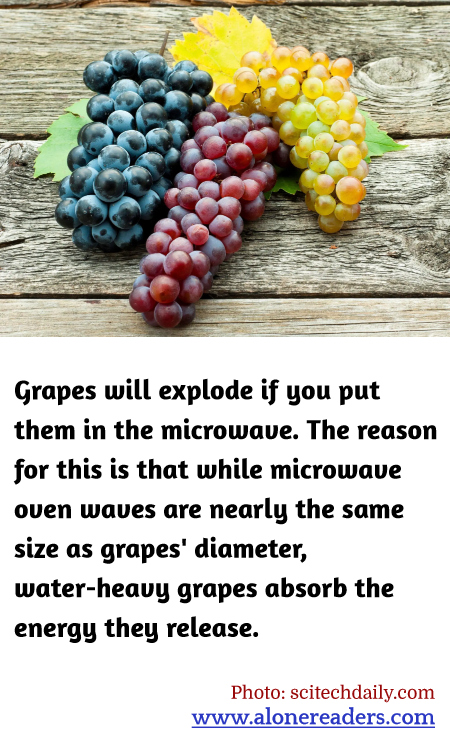
Grapes are a common household fruit, often enjoyed fresh, in salads, or as a frozen treat. However, an unusual phenomenon occurs when they're placed in a microwave — they can explode. This surprising reaction is due to the interaction between microwave radiation and the unique structure of grapes.
Microwave ovens cook food using electromagnetic waves. The wavelength of these microwaves is about 12 centimeters, which allows them to effectively penetrate food and excite water molecules, heating the food quickly. Grapes, typically about an inch in diameter, are small but have a high water content. When microwaved, the waves are concentrated on these water-rich fruits.
The skin of a grape is relatively impermeable, and as the water inside the grape heats up, it turns into steam. As the steam builds up, pressure accumulates within the grape because the steam cannot escape quickly enough through the grape's skin. Eventually, this pressure becomes too great for the grape to contain, leading it to explode.
Interestingly, cutting a grape nearly in half and leaving a small piece of skin connecting the two halves can also lead to sparks and plasma formation. In this scenario, the electromagnetic waves super-heat the ions in the grape, and the connected skin acts as a conduit for electrical conductivity. This can create a bright flash of light and a significant release of energy, often more intense than the simple explosion of a whole grape.
The exploding grape experiment is a vivid demonstration of the interactions within microwave heating and is popular in science classes to illustrate principles of heat, pressure, and phase changes of water. Though it might be tempting to try this at home, it's important to remember that experimenting with microwaves can damage the appliance or cause injury. Microwaves are designed for cooking conventional foods and should be used according to the manufacturer's instructions to ensure safety.
