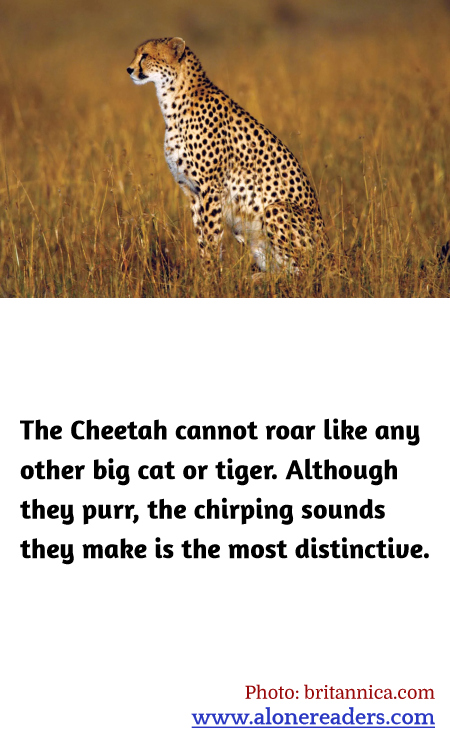
Cheetahs, majestic and swift, stand out distinctly among the big cats for several reasons, notably their vocalizations. Unlike lions, tigers, and leopards, cheetahs cannot roar. This difference in vocal ability is due to the structure of the larynx. While the other big cats possess a ligament structure within the larynx that can stretch and produce a deep, resonating roar, the cheetah's larynx does not have this adaptation.
Instead of roaring, cheetahs use a variety of other sounds to communicate. One of their most charming and unique vocalizations is a bird-like chirping sound. This chirp can be quite loud and is used primarily for locating other cheetahs. A mother may chirp to call her wandering cubs, or an individual might use it to reconvene with other members of a group.
Another notable sound in the cheetah's vocal repertoire is the purr. Similar to a domestic cat, cheetahs will purr when content, often during grooming or when resting. This purring serves as a signal of their relaxed state and is typically used in close-range communication with other cheetahs. The purr also has a nurturing role, particularly between mothers and their cubs.
The reasons behind the cheetah's inability to roar and its alternative communication methods likely relate to its ecological and physical characteristics. Cheetahs are built for speed, with lightweight bodies and long, slender limbs. This design, perfect for high-speed chases, might not accommodate the robust vocal apparatus required for roaring. Additionally, cheetahs do not defend territories in the same way that other big cats do but rely more on stealth and surprise, which may be aided by less powerful, more subdued vocalizations.
In summary, the cheetah's vocal communication significantly contrasts with other big cats. This difference highlights the unique evolutionary path cheetahs have taken, adapting over time to their specific environmental niches and survival strategies. The chirp, delightful and distinct, not only underscores the cheetah's uniqueness among big cats but also serves critical communication roles in their social and familial interactions.
