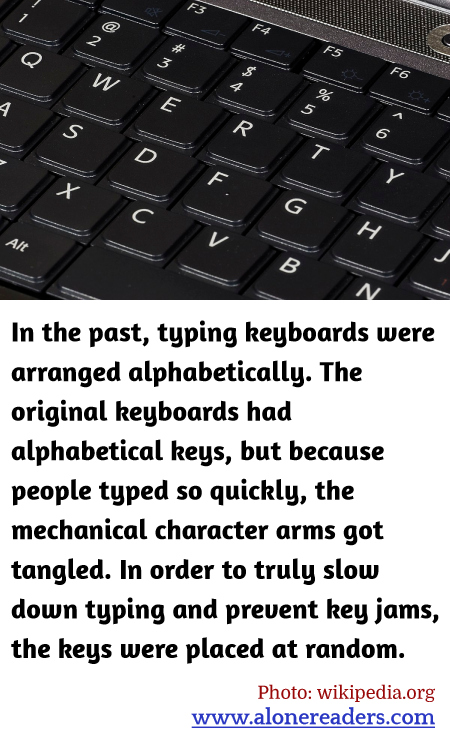
In the early days of typewriting, keyboard layouts were indeed different from what most of us are familiar with today. The first commercial typewriters were introduced in the 1870s, and one of the earliest models created by Christopher Latham Sholes featured keys arranged in alphabetical order. This layout, while seemingly intuitive, led to mechanical issues and inefficiency in typing speed.
The problem with the alphabetical layout was related to the mechanics of the typewriters. Typewriters of that time used a mechanism where each key was attached to a metal arm. When a key was pressed, the corresponding arm would swing forward to strike the ink ribbon and make an imprint on the paper. However, the alphabetical arrangement led to frequent jams. This was especially true for commonly used letters being placed close to each other, causing their respective type bars to collide if typed in quick succession.
To resolve this issue, Sholes and his colleagues began experimenting with different arrangements to minimize the jamming. The result of their efforts was the QWERTY layout, introduced in the 1870s. This layout strategically placed commonly used letter pairs in such a way that their type bars were less likely to intersect and jam. Contrary to popular belief, the purpose wasn't to slow down typing but rather to speed it up by reducing stops caused by jams.
The QWERTY layout did not catch on immediately. However, its utility in preventing jams became apparent as typing speeds increased. Its adoption was further solidified by the success of the Remington No. 2 typewriter, which was one of the first machines to use the QWERTY layout. As more people learned to type on these machines, the layout became standardized due to familiarity and the training required for other arrangements.
Today, the QWERTY layout is the most widely used keyboard arrangement across the English-speaking world, largely due to its historical precedence and the vast infrastructure built around it, from typing education to manufacturing. Although alternative layouts like Dvorak and Colemak offer reduced finger movement and increased typing efficiency, the switch costs and retraining requirements have hindered their widespread adoption.
In summary, the transition from alphabetical keyboards to the QWERTY layout in typewriters was a pivotal development driven by the need to avoid mechanical jams and increase typing efficiency, rather than an attempt to slow down typing as is commonly misconceived. This layout has endured largely because of its early adoption and the subsequent training and manufacturing ecosystems that developed around it.
