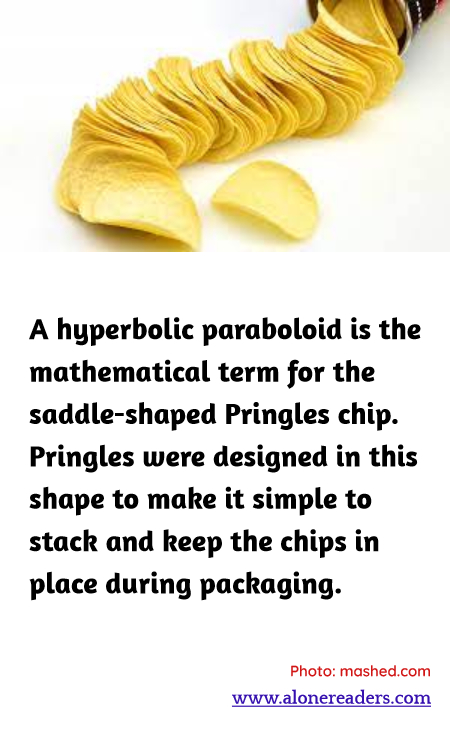
The hyperbolic paraboloid, an intriguing surface in mathematics, finds a surprisingly delicious application in the world of snack foods. Most notably, this geometric shape is the foundation for the iconic Pringles potato chip. Unlike traditional flat or irregularly shaped chips, each Pringle chip boasts a uniform saddle shape, technically known as a hyperbolic paraboloid. This precise curvature allows the chips to be stacked neatly, one atop the other, which is a distinct feature of their packaging.
The design of Pringles was driven by a desire to create a chip that could be easily stacked, reducing the space needed for packaging and minimizing damage to the chips during shipping. Traditional chips, which are often bagged loosely, tend to break under their own weight and during transport. In contrast, Pringles' unique shape and the canister they come in together help keep the chips intact from factory to consumption.
The choice of a hyperbolic paraboloid shape is particularly clever from a mathematical standpoint. This surface is defined by a saddle point, a type of critical point that is neither a local maximum nor a local minimum. It curves upward in one direction and downward in the other, which inherently gives Pringles their strength and stackability. This structural integrity means that, when stacked, the convex curve of one chip neatly nests into the concave curve of the next, forming a tight cylinder that is resistant to being crushed.
Engineering the perfect Pringle was no small feat; it required precise calculations and innovative technology to transform a mix of mashed potato into the desired shape. The process involves using a form known as a saddle, which molds the potato mixture before it is sliced, cooked, and dried into the final crisp product. This method ensures that each chip is an identical hyperbolic paraboloid, leading to the uniform stacks that Pringles is known for.
Thus, the hyperbolic paraboloid does not only spark interest in the fields of architecture and engineering for its aesthetic and structural qualities but also holds a place of honor in the pantheon of snack foods. This fusion of mathematics, engineering, and culinary art shows how interdisciplinary approaches can lead to innovation, even in seemingly simple everyday products like potato chips.
