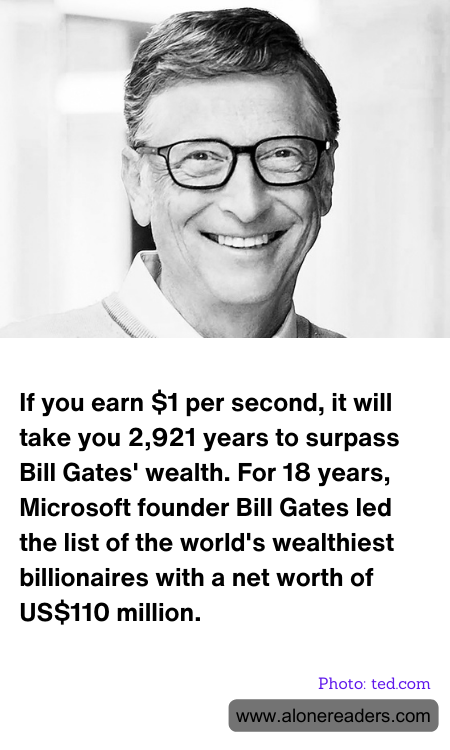
Earning $1 per second sounds fantastic until you put it into perspective against the immense wealth of individuals like Bill Gates. If you were to earn money at this rate, continuously, without spending a single penny, it would still take you a staggering 2,921 years to match the net worth of Bill Gates at his financial peak. To understand this better, one must consider that earning $1 per second translates to $86,400 per day, and approximately $31.5 million per year—a significant sum by any standard, yet minuscule in the face of Gates' billions.
Bill Gates, the co-founder of Microsoft, has been a perennial fixture atop the list of the world's wealthiest individuals. At one point, his net worth was estimated at about US$110 billion. This immense wealth accumulation is attributed not only to his ownership and involvement in Microsoft but also to his investments and various assets across different sectors. For eighteen consecutive years, Gates led the global list of billionaires, underscoring a period of unprecedented personal wealth growth that was closely intertwined with the digital revolution spearheaded by Microsoft.
Gates' wealth is a testament to the scale and potential of technological innovation and market dominance. Microsoft became essential to personal and corporate computing, capturing vast global market shares with its operating systems and office tools. Thus, comparing such a colossal figure to $1 per second helps highlight the sheer scale of top-tier wealth accumulations in modern economies and the exceptional nature of Gates' financial achievements.
The illustration also underscores the broader discourse about wealth inequality, which has become a hot topic globally. Such comparisons bring into sharp relief the disparities in income and the concentration of wealth in the hands of a few. While Gates has dedicated a large portion of his wealth to philanthropy, aiming to combat global challenges through the Bill & Melinda Gates Foundation, the discussion about wealth, income distribution, and economic equity continues to be a significant point of debate in economic and social circles.
Reflecting on earning $1 per second relative to accumulating over $100 billion puts into perspective not just the personal success of Bill Gates, but also the broader economic structures that enable such a disparity in wealth accumulation. This serves as a catalyst for discussions on economic policies, wealth distribution, and the role of innovation and entrepreneurship in shaping economic landscapes around the world.
