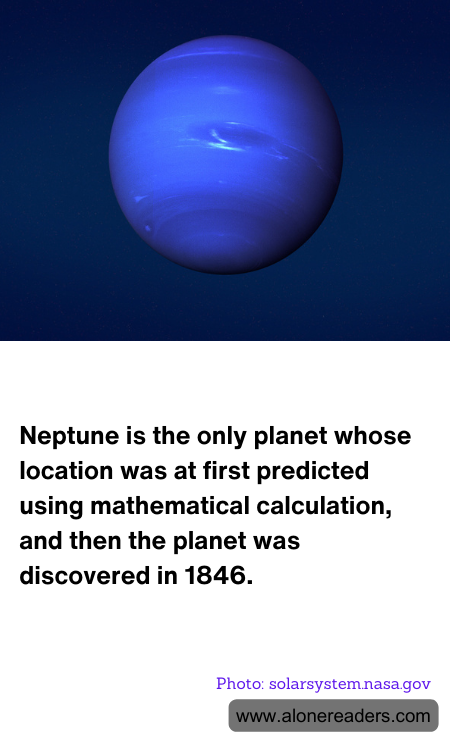
Neptune, the eighth and farthest known planet from the Sun in our solar system, stands out for the unique manner in which it was discovered. Unlike other planets, which were initially seen through telescopes or by naked-eye observations, Neptune's existence was first predicted mathematically due to unexplained irregularities in the orbit of Uranus. Following the discovery of Uranus in 1781, astronomers noticed that its orbit was not following the expected path based on Newtonian mechanics. This led to speculation that another, farther planet might be exerting a gravitational pull on Uranus.
To solve this celestial puzzle, French mathematician Urbain Le Verrier and British mathematician John Couch Adams independently calculated the possible location of this unknown planet. Le Verrier sent his calculations to Johann Gottfried Galle at the Berlin Observatory, who, on September 23, 1846, aimed his telescope at the coordinates suggested by Le Verrier. That very night, Galle and his assistant Heinrich d'Arrest identified Neptune almost exactly where Le Verrier had predicted it would be.
The discovery of Neptune was a remarkable validation of Newtonian physics and a testament to the predictive power of mathematics in astronomy. It was also a monumental moment in the history of science, as it marked the first and only time a planet’s position was predicted before it was directly observed. This method of discovery also underscored the dramatic leap in human understanding and technological capability in the field of astronomy.
Neptune itself is a giant ice planet, composed primarily of hydrogen, helium, water, ammonia, and methane. The planet is known for its striking blue color, a result of methane in the atmosphere absorbing red light and reflecting blue light. It has a very active climate system with the strongest winds in the solar system, reaching speeds of up to 2,100 kilometers per hour. Neptune also has a faint ring system and 14 known moons with Triton, the largest, believed to be a captured Kuiper Belt object.
The story of Neptune’s discovery is not just an episode from the past but continues to influence current astronomical methods and stimulates the ongoing search for planets beyond our solar system, particularly with the advent of more powerful telescopes and refined mathematical techniques. The process that led to its identification helped lay the groundwork for the search techniques used to discover exoplanets in the distant star systems today, bridging two centuries of astronomical advancement.
