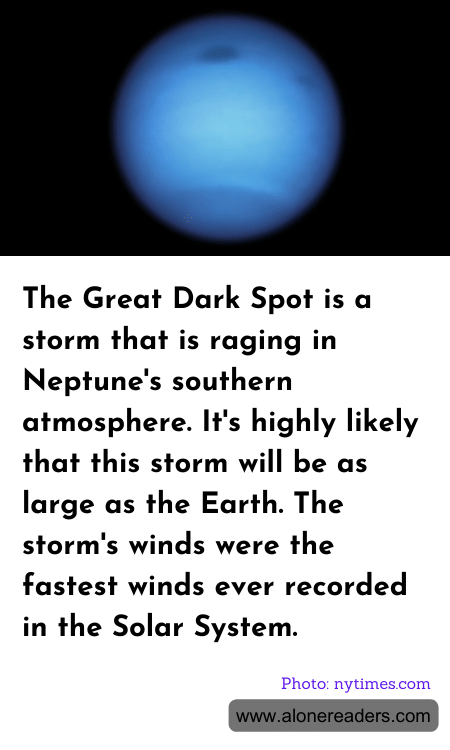
The Great Dark Spot on Neptune is one of the most intriguing atmospheric phenomena observed in our solar system. Discovered in 1989 by NASA's Voyager 2 spacecraft during its flyby of the planet, it presented a giant, high-pressure storm system similar in appearance to Jupiter’s Great Red Spot. The storm, located in Neptune's southern hemisphere, is notable for its size, which rivals that of Earth itself, stretching approximately 13,000 kilometers by 6,600 kilometers.
This massive storm is marked by extremely high wind speeds, which are the fastest recorded in the solar system, reaching up to 2,100 kilometers per hour. These fierce winds whip around the planet in an anticlockwise direction, possibly driven by the internal heat of Neptune combined with the absorption and redistribution of solar energy. The dark color of the Great Dark Spot is believed to be caused by the atmospheric gases and the storm's ability to lift frozen methane from deeper layers of Neptune's atmosphere to higher, colder regions, where it condenses into ice crystals.
The dynamics and longevity of the Great Dark Spot are subjects of active research. Neptune’s storms seem to be relatively transient compared to Jupiter’s Great Red Spot; they might form and dissipate over several years. This was evidenced when the Hubble Space Telescope observed Neptune in the early 1990s, and the Great Dark Spot had vanished. However, new dark spots had appeared on other parts of Neptune, suggesting a dynamic atmosphere where storms can continuously reform.
The study of such gigantic storms provides crucial insights into the meteorological processes of other planets and helps enhance our understanding of Earth's atmosphere by comparison. With ongoing advances in astronomy, and particularly with newer, more capable space telescopes, our understanding of Neptune’s wild weather continues to grow, revealing complexities that challenge our models of planetary atmospheres and dynamical systems.
