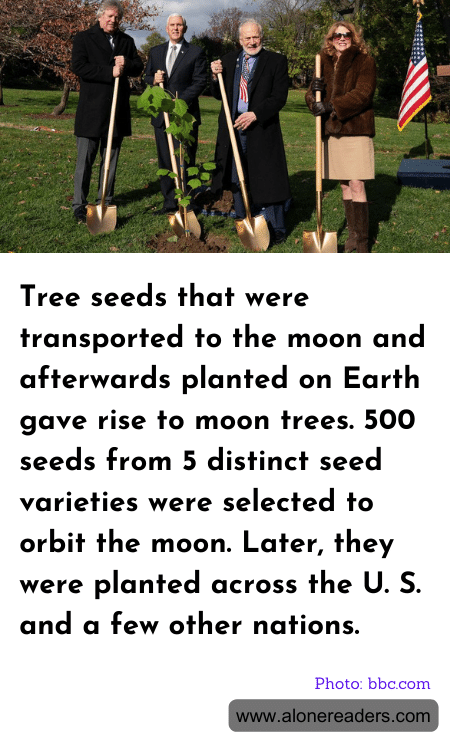
In the late 1960s and early 1970s, an intriguing botanical experiment involved sending tree seeds to the moon and then planting them back on Earth, giving rise to what are now known as "moon trees." During the Apollo 14 mission in 1971, Stuart Roosa, a former U.S. Forest Service smoke jumper and the command module pilot, took about 500 seeds from various tree species into space as part of a joint NASA-U.S. Forest Service project. The species included loblolly pine, sycamore, sweetgum, redwood, and Douglas fir.
These seeds orbited the Moon, and after returning to Earth, were germinated as part of a scientific experiment to observe the effects of space travel on living organisms. The goal was to see if the seeds would still grow normally after being exposed to the conditions in space, including microgravity and high levels of cosmic radiation. The results were positive, and most of the seeds germinated successfully.
The saplings were then distributed across the United States and to several other countries—including Brazil, Switzerland, and Japan—to be planted as part of the United States bicentennial celebrations in 1976. These trees were planted in a variety of locations, such as public parks, schools, universities, and government institutions, often accompanied by plaques explaining their unique lunar legacy.
Moon trees serve not only as living reminders of the human quest to explore space but also as a testament to the resilience of life. Despite their extraterrestrial journey, they grew without any discernible differences compared to their Earth-bound counterparts. Research continues on second-generation seeds from these trees to further understand the long-term impacts of space travel on living organisms. Today, moon trees remain a symbol of scientific curiosity and a reminder of how even the simplest forms of life can connect us to the broader universe.
