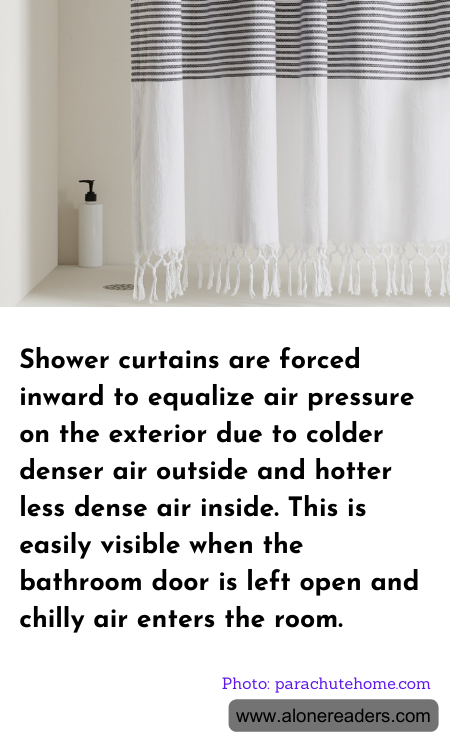
When you take a hot shower, the warm water vapor increases the air temperature inside the shower, making it lighter and less dense. At the same time, if the bathroom door is left open, cooler and denser air from outside the bathroom can enter. This temperature discrepancy creates a low-pressure system inside the shower area and a relatively higher pressure outside of it.
The basic principles of physics dictate that air moves from areas of higher pressure to areas of lower pressure to equalize the difference. This movement of air is what causes the shower curtain to billow inwards towards the shower. This phenomenon is often referred to as the shower curtain effect and is a practical demonstration of Bernoulli's principle. According to this principle, an increase in the speed of a fluid occurs simultaneously with a decrease in pressure.
Moreover, the inward movement of the shower curtain is not solely due to air flow and pressure differentials. The rising steam and the heat of the shower also create a thermal updraft. As hot air rises, cooler air rushes in from the lower part of the bathroom, including under the door, to replace the rising air. This causes additional movement of air towards the inside of the shower, further sucking the curtain inward.
Combatting this annoying flutter of the curtain can be as simple as using heavier or weighted shower curtains. Some curtains come with magnetic strips or suction cups to help attach them to the walls of the shower, thus minimizing their inward movement. Additionally, ensuring the bathroom is well-heated or slightly opening a window to balance out the air temperature can mitigate these effects, making for a more comfortable shower experience.
