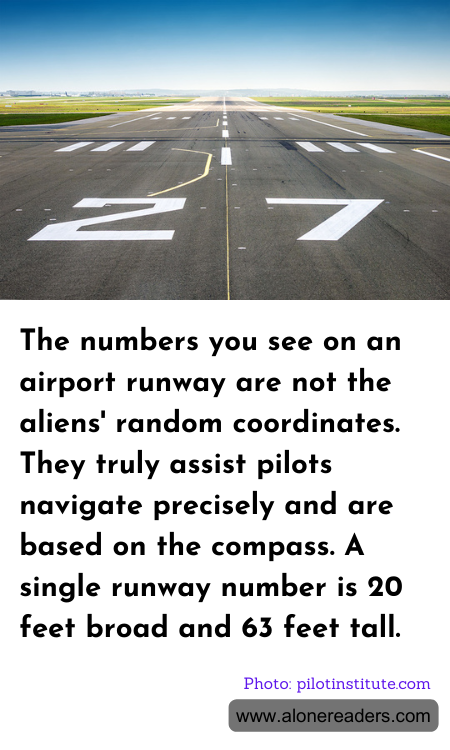
Navigating through the sprawling expanse of an airport, one might wonder about the significance of the large, often white numbers painted on the runway's surface. Far from arbitrary, these numbers are crucial navigational aids that every pilot relies on to ensure safe takeoffs and landings. Contrary to any whimsical notions of alien coordinates, the explanation lies in the practical and precise world of compass directions.
Each set of numbers on a runway corresponds directly to the runway's orientation in relation to magnetic north. This orientation is rounded to the nearest tenth degree and then divided by 10 to provide a simpler figure for ease of communication and recall. For example, a runway pointed toward 135 degrees on the compass would be labeled as 14, representing 140 degrees when the figure is multiplied by 10. This system helps pilots align their approach or departure with the runway, particularly in poor visibility conditions.
These numbers also adjust in inverse to accommodate runways that can be used from either direction. For instance, a runway marked as 14 on one end will be marked as 32 on the opposite end, indicating a compass bearing of 320 degrees. By simply adding or subtracting 180 degrees (half of the 360-degree compass), pilots can easily determine the direction for the opposite end of the runway.
The size of these numbers is not incidental either. While the specific dimensions can vary by airport, with some measurements like 20 feet in width and 63 feet in height, the overarching goal is visibility. These dimensions ensure that the numbers are visible from the air even at considerable distances, aiding pilots in confirming that they are indeed aligned with the correct runway.
In essence, runway numbers are an elegant solution to the complex requirement of spatial orientation in the three-dimensional space of flight. They ensure standardized, safe, and efficient operations at airports around the world, guiding pilots during some of the most critical phases of flight, day or night, and in varying weather conditions. Thus, the next time you gaze out the plane window at those giant runway numbers, you're looking at one of aviation's simplest yet most effective tools.
