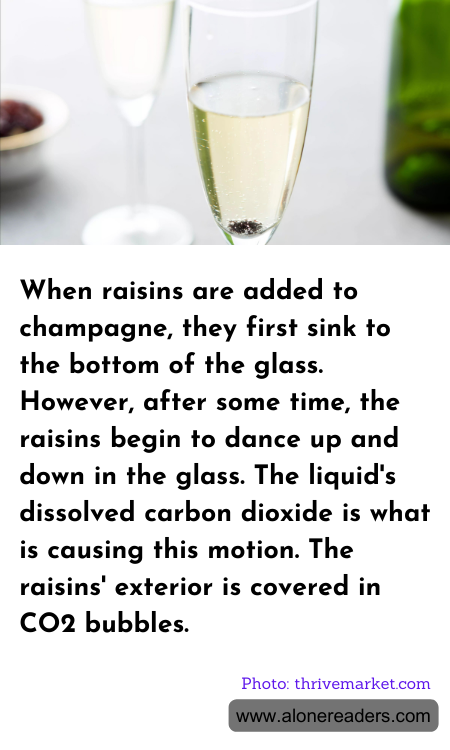
When raisins are dropped into a glass of champagne, they initially sink due to their higher density compared to the liquid. As they settle at the bottom, an interesting phenomenon occurs that brings these tiny dried fruits back to life in a playful dance. This is caused by the carbon dioxide (CO2) bubbles that are a natural part of champagne, a sparkling wine known for its effervescence.
Champagne undergoes a fermentation process that leaves it saturated with dissolved carbon dioxide. When the bottle is opened, the pressure inside the bottle decreases, allowing the CO2 to escape in the form of bubbles. When raisins are added, they provide perfect points of nucleation. The rough surface of a raisin, often covered in microscopic ridges and crevices, makes it easier for CO2 bubbles to form. These bubbles accumulate on the surfaces of the raisins, particularly in the crevices.
As more and more bubbles form, they eventually create enough buoyancy to lift the raisin. The combined volume and buoyant force of these adhering bubbles counteract the density and weight of the raisin, allowing it to rise to the surface. Upon reaching the surface, the bubbles pop upon contact with the air, releasing the CO2 and causing the raisin’s density to once again surpass that of the surrounding liquid. The raisin then sinks back down to the bottom of the glass to repeat the process. This cycle of rising and falling continues, creating the charming effect of dancing raisins.
The motion is not just amusing but also serves as an interesting demonstration of physical principles such as buoyancy, nucleation, and gas solubility in liquids. The same principle explains the behavior of other objects in carbonated beverages and can be an entertaining and educational experiment to observe. Whether it's at a lively party or a quiet evening at home, adding raisins to your champagne can bring a touch of whimsy and science to your drink.
