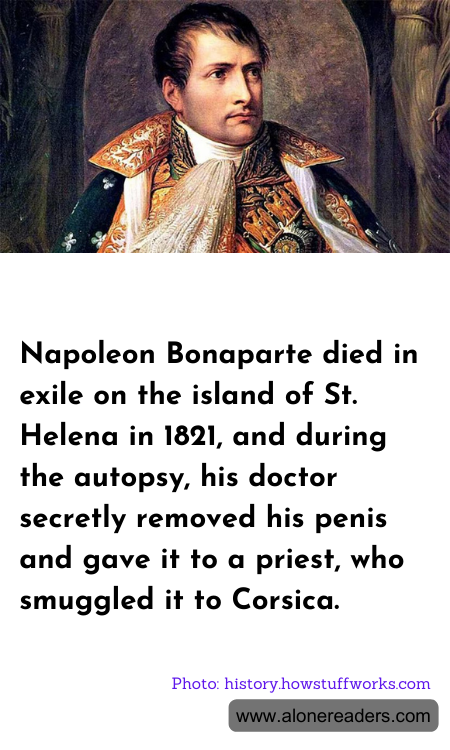
Napoleon Bonaparte’s final days were spent in forced isolation on the remote island of St. Helena, where he died on May 5, 1821. His demise was an ignoble end for the former emperor of France, who once dominated Europe with his military genius. What followed his death, however, turned into a series of macabre and bizarre events, reflecting the ongoing fascination and controversy surrounding his figure.
During Napoleon’s autopsy, conducted by his physician, François Carlo Antommarchi, multiple parts of his body were removed, not uncommon in the era for someone of his prominence, as relics. In an extraordinary and gruesome twist of events, it is said that Napoleon’s penis was also removed during this procedure. According to various accounts, it was the priest, Abbé Angé Paul Vignali, who conducted the last rites, who ultimately came into possession of this strange artifact. As the story goes, the penis was quietly removed, perhaps as a bizarre memento mori or out of some other unknown motivation.
This relic then reportedly embarked on its own peculiar journey, initially smuggled to Corsica. Over the decades, Napoleon’s penis supposedly changed hands multiple times, becoming an object of clandestine fascination across continents. It is alleged to have been displayed in an exhibition in New York in the 1920s before finally being sold to an American urologist in the 1970s, who kept it until his death.
The veracity of these events is shrouded in mystery and skepticism. Much of what is known comes from second-hand accounts and the credibility of these stories is often questioned. The practice of removing body parts as souvenirs was indeed practiced in the era, reflective of both the morbid curiosity and deep reverence held for historical figures. Nonetheless, the tale of Napoleon’s genitalia is perhaps an extreme example of how the lore surrounding iconic historical figures can evolve.
This strange postscript to Napoleon’s life underscores not only the enduring legacy of the man but also the sometimes grotesque lengths to which admirers or the curious will go. It highlights the intersection of history with myth and how the latter can often overshadow the former, turning solemn moments into subjects of intrigue and scandal. For Napoleon, a man whose life was dedicated to the soar and tumble of power, perhaps it’s an oddly fitting continuation of a legacy filled with both grandeur and infamy. It invites reflection on how we remember historical figures, the aspects of their lives we choose to emphasize, and the artifacts we preserve, both physical and anecdotal.
