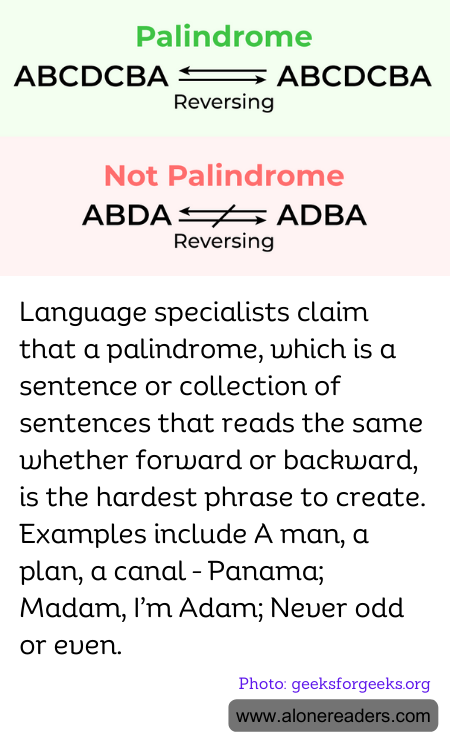
Palindromes, with their unique quality of reading the same forwards and backwards, present a significant challenge in language construction. The creation of palindromes goes beyond simple word play, requiring not only a knack for pattern recognition but also a deep understanding of language structure. These phrases can vary in length from single words like "level" or "radar" to more complex sentences such as "A man, a plan, a canal – Panama!" which maintains its syntactic and semantic integrity no matter which direction it is read.
The complexity in crafting palindromes lies in their strict structural symmetry. This requires the constructor to carefully balance letters and phrases such that they mirror each other perfectly, often leading to inventive uses of language and punctuation. For example, "Madam, I’m Adam" not only relies on the mirroring of letters and words but also cleverly incorporates punctuation to maintain the balance. The phrase strategically places a comma and an apostrophe to ensure that each half of the palindrome reflects the other accurately.
Language experts find the palindrome fascinating not just for its linguistic artistry but also for its potential to expand our understanding of language mechanics. The palindrome challenges traditional word order and syntax, pushing the boundaries of how we typically structure sentences. In constructing these phrases, one must think in a non-linear way, predicting how each word or letter will interact as part of a larger, cohesive whole that reads identically in either direction.
The appeal of palindromes extends beyond linguistic circles, intriguing puzzle lovers and linguists alike. Their charm lies in the aha-moment when the symmetry unveils itself, delivering pleasure not only through their meaning but through their form as well. This unique blend of linguistic challenge and aesthetic delight makes them a fascinating subject of study and enjoyment.
Constructing a palindrome requires patience, linguistic sensitivity, and a playful approach to language. It is a testament to the creativity inherent in human linguistic expression. The palindrome doesn’t just play with language—it also plays with our perception of it, challenging us to engage with text in a dynamically interactive way, making it one of the most intriguing linguistic phenomena.
