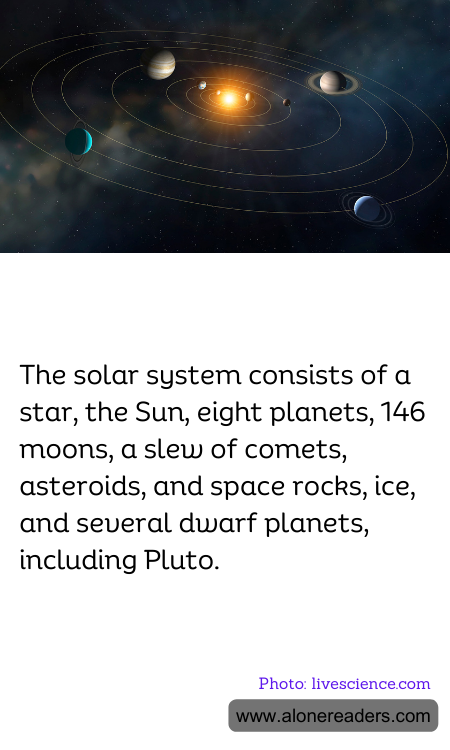
The solar system, a fascinating and complex network of celestial bodies, is anchored by the Sun, a central star that holds everything in its orbit through its gravitational pull. This massive star, composed primarily of hydrogen and helium, supplies the necessary light and heat to support life on Earth and influences the conditions on other planetary bodies.
Around the Sun, eight major planets, each with its unique characteristics and compositions, form a dynamic system of worlds. These include the rocky inner planets—Mercury, Venus, Earth, and Mars—and the gas giants and ice giants that make up the outer planets—Jupiter, Saturn, Uranus, and Neptune. Earth, with its conducive atmosphere and presence of water, remains the only known planet to support life, making it uniquely significant among its peer planets.
Beyond the planets, the solar system is home to 146 moons, each orbiting their respective planets, contributing to a wide variety of surface and atmospheric conditions. For instance, Jupiter's moon Europa and Saturn's moon Enceladus are believed to hold vast oceans beneath their icy crusts, possibly harboring the conditions necessary for life.
The solar system also contains myriad smaller bodies such as asteroids, comets, and meteoroids. Predominantly found in the asteroid belt between Mars and Jupiter, these rocky bodies vary greatly in size and composition, offering valuable clues about the early solar system's conditions. Comets, composed of ice, dust, and rocky material, are famously known for their spectacular glowing comae and tails that develop when they come close to the Sun.
Additionally, several dwarf planets, including Pluto, Eris, and Haumea, populate the solar system. These bodies share similarities with the eight primary planets but do not clear their neighboring region of other debris. Pluto, perhaps the most famous of these, was classified as the ninth planet until 2006 when it was reclassified as a dwarf planet, leading to much debate in the scientific community and public alike.
The solar system remains a topic of constant discovery and intrigue, with ongoing missions exploring farther reaches and revealing more about the complexities and dynamics of this celestial neighborhood. In understanding our solar system, we not only uncover the history of our own planet but also the potential for life elsewhere in the universe.
