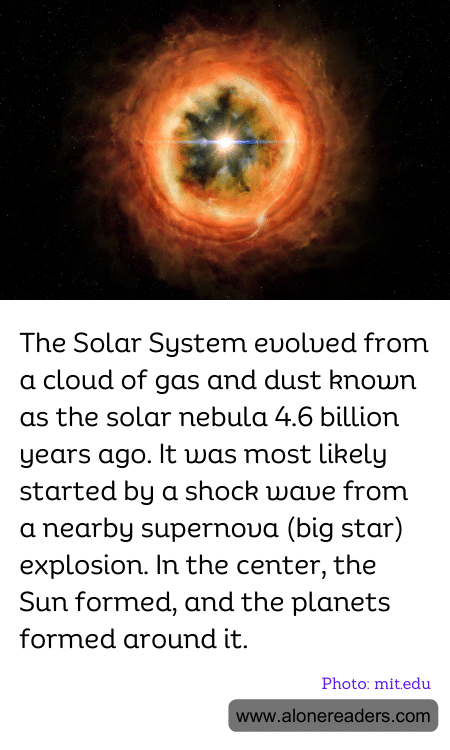
Our solar system's origins stretch back approximately 4.6 billion years, when a vast cloud of gas and dust began to collapse under its own gravity. This process, probably triggered by the shockwave from a nearby supernova explosion, led to the formation of the solar nebula—a spinning, flattened disk of material. At the center of this nebula, where most of the material accumulated, the Sun was formed.
As the Sun gathered mass and began its nuclear fusion, the remaining material in the disk started to coalesce into smaller clumps, which gradually grew into the planets, moons, asteroids, and comets that orbit our star today. This process of planetary formation is governed by the forces of gravity and angular momentum, which helped shape the architecture of the solar system as we observe it now.
The inner solar system, where the Earth resides, is made up predominantly of rocky planets and asteroids, whose materials could withstand the higher temperatures near the Sun. Meanwhile, the outer solar system hosts gas giants and icy bodies, formed in the cooler environments far from the Sun's intense heat. These regions are separated by the asteroid belt, a zone filled with rocky remnants from the early solar system that never coalesced into a planet.
Understanding the solar system's formation offers not only insights into our own cosmic neighborhood but also clues about the creation of other planetary systems across the galaxy. As technology advances, astronomers continue to detect exoplanets in far-reaching systems, each with unique properties but similarly reflective of the dynamic processes that formed our own solar system.
