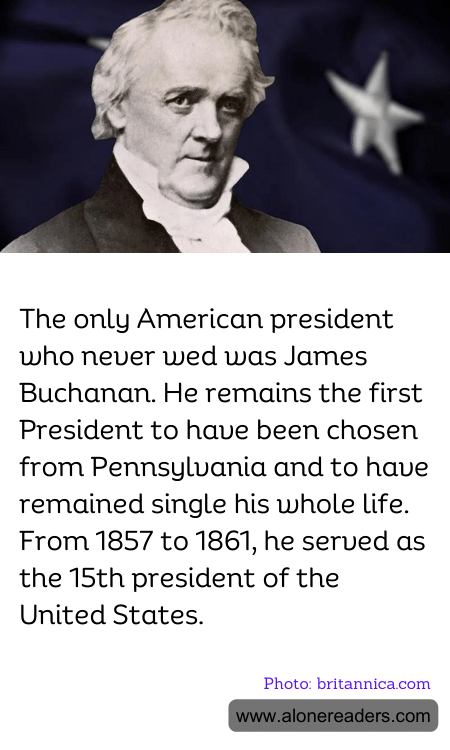
James Buchanan, an influential figure in American history, holds the unique distinction of being the only bachelor President of the United States. Born on April 23, 1791, in Cove Gap, Pennsylvania, Buchanan was the first president to hail from Pennsylvania—a point of pride for the state. His tenure as the 15th president spanned from 1857 to 1861, a period marked by intense national division and the foreshadowing of the Civil War.
Before his presidency, Buchanan had an extensive career in public service. He served as a member of the Pennsylvania House of Representatives, a U.S. Congressman, the Minister to Russia under President Andrew Jackson, and the Secretary of State under President James K. Polk. Despite his impressive resume, his presidency is often viewed critically for his inability to ameliorate the escalating tensions between the northern and southern states.
Buchanan’s personal life, particularly his bachelorhood, has been a subject of considerable historical interest and speculation. Some historians suggest his lifelong single status might have influenced his presidency, as it was an era when social and familial connections were crucial in politics. Throughout his life, Buchanan was close to his niece, Harriet Lane, who assumed the duties of First Lady during his presidency and was a popular figure in her own right.
Despite Buchanan’s extensive experience, his presidency did not successfully bridge the growing divide within the country. His policies and decisions, particularly regarding states' rights and the expansion of slavery, did not halt the course towards civil strife. The Dred Scott decision of 1857, which occurred shortly after he took office, ruled that Congress could not regulate slavery in the territories, inflaming sectional tensions to unprecedented levels and severely undermining Buchanan’s position.
Assessments of Buchanan's presidency have generally been harsh, with many scholars placing him at the lower end of presidential rankings due to his administration's failure to prevent the secession of the Southern states, which ultimately led to the outbreak of the Civil War. Critics argue that his indecisive leadership contributed to the fragmentation of the Union, setting the stage for Abraham Lincoln to face the monumental task of restoring the nation.
In retrospect, James Buchanan’s presidency exemplifies how personal characteristics and societal challenges can profoundly impact presidential leadership. Despite his unmatched political experience, his presidency is often remembered more for its shortcomings than for its accomplishments. Buchanan’s legacy serves as a study in the complexities of leadership during one of America’s most turbulent periods.
