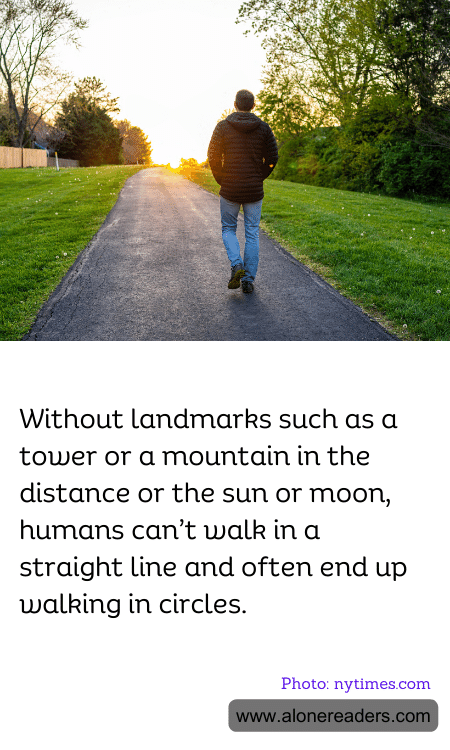
Though it may seem a straightforward task, walking in a straight line without visual reference points such as mountains, towers, or celestial bodies like the sun or moon is surprisingly challenging. This phenomenon begs exploration into how humans orient themselves and navigate through space.
Humans possess a variety of senses; however, our perception and spatial orientation heavily depend on visual cues. Without distinct landmarks, our navigation skills often falter. This phenomenon has been observed both in controlled environments and natural settings. Several studies have demonstrated that in the absence of visual landmarks, people tend to walk in loops rather than straight lines, often veering back to their points of origin.
One explanation for this behavior is our reliance on the vestibular system located in the inner ear, which helps control balance and eye movements. This system works in harmony with visual and proprioceptive feedback to maintain direction and posture. When reliable visual cues are absent, minor errors in the vestibular or proprioceptive systems can cause a deviation in the intended path, which over time may lead to circular or looping paths rather than straight lines.
The natural environment plays a crucial role in our spatial orientation. For instance, without the sun’s position to guide us during the day or the moon and stars at night, estimating direction becomes significantly more difficult. Humans often use the sun’s trajectory from east to west to orient themselves, a method that has been employed since ancient times. Similarly, the moon and stars have served as navigational guides for night-time travel across various cultures.
Research in this area uses interesting methodologies, such as blindfolding participants or asking them to walk in dense forests or deserts where large landmarks are obstructed. The outcomes consistently reveal that human navigation is imperfect without external cues. This tendency to walk in circles has implications for search and rescue operations, emphasizing the importance of navigational tools and strategies in environments where landmarks are sparse or non-existent.
Understanding why humans struggle to maintain a straight path in such conditions not only sheds light on the limitations of human perception and cognition but also underscores the interplay between our sensory systems and the environment. It reminds us of the sophistication of ancient navigational methods that utilized the natural world, and how, even with advanced technology, humans still sometimes rely on the fundamental cues provided by nature to find their way.
