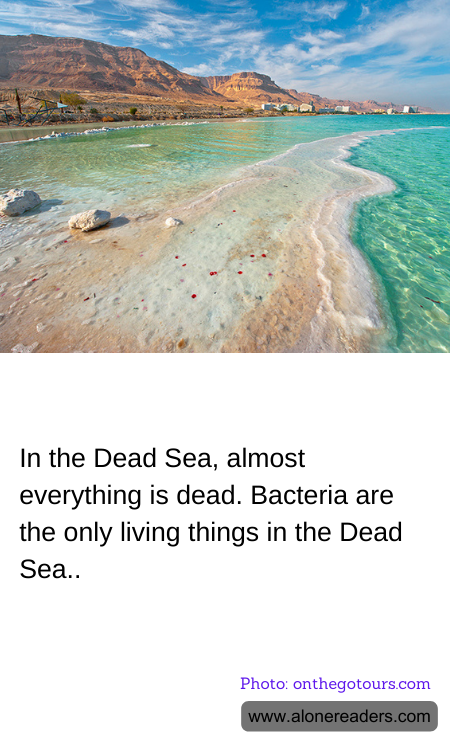
The name "Dead Sea" aptly describes the high saline environment where typical marine life cannot exist. Situated at the lowest point on Earth, this hypersaline lake borders Jordan to the east and Israel and the West Bank to the west. Famous for its extreme saltiness—about nine times saltier than the ocean—the Dead Sea creates an environment in which few organisms can survive. Consequently, its aquatic landscape is stark and largely devoid of life forms typically found in less saline bodies of water.
Despite its uninhabitable reputation, the Dead Sea is not entirely devoid of life. Microorganisms such as bacteria and microbial fungi have adapted to its harsh conditions. These extremophiles have developed unique biochemical pathways that enable them to cope with high salinity and intense UV radiation exposure that would be lethal to most other life forms. Among the most notable of these are the halophiles, bacteria that thrive in high salt concentrations, which not only survive but also flourish in this saline environment.
Researchers studying these resilient organisms believe that understanding how they live in such extreme conditions can offer insights into possible life on other planets with harsh environments. Additionally, halophiles are of significant interest to biotechnology and medicinal research, offering potential applications ranging from the creation of salt-tolerant crops to the development of new therapeutic compounds.
In an ecological and geographical context, the Dead Sea is also significant due to its rapid rate of evaporation and shrinking size. This phenomenon prompts environmental and economic concerns, affecting local water resources, climate, and industries such as Dead Sea mineral extraction for skincare and health products.
The Dead Sea remains a site of fascination, whether for its unique biological inhabitants, its extreme environmental features, or its historical and cultural significance. It serves as a natural laboratory for scientific research, a challenging environment for studying extremophile organisms, and a stark reminder of nature’s extremes. Its ongoing ecological changes also signal urgent issues related to water management and environmental preservation in the region.
